
Product Knowledge
What Is Saran Wrap Made Of? It Changed in 2004 (Most Don't Know)
What Is Saran Wrap Made Of? Materials, History & Why It Changed
What is saran wrap made of? Modern Saran Wrap (the S.C. Johnson brand) is made from LDPE — low-density polyethylene. But the original Saran Wrap (1953-2004) was made from PVDC — polyvinylidene chloride, a completely different plastic with far stronger cling. Commercial cling wrap used in supermarkets and restaurants is typically PVC (polyvinyl chloride) with food-grade plasticizers. “Saran Wrap” is the American brand name for thin, transparent plastic food wrap — a genericized trademark like Kleenex or Band-Aid — used throughout the US and Canada to mean any plastic cling wrap, regardless of brand or material. In other English-speaking countries, the same product is called cling film (UK/Europe), cling wrap (Australia/NZ), or simply plastic wrap.
| Term | Region | Is It a Brand? | Typical Material Today |
|---|---|---|---|
| Saran Wrap | US, Canada | Yes (S.C. Johnson) | PE (current brand) |
| Plastic wrap | US (generic) | No | PE or PVC |
| Cling film | UK, Europe, Asia | No | PVC or PE |
| Cling wrap | Australia, NZ | No | PVC or PE |
| Glad Wrap | Australia, NZ | Yes (Clorox) | PE |
| Food wrap | Commercial / food-service | No | Mostly PVC |
| Papel film | Spain, Latin America | No | PVC or PE |
The original Saran Wrap (1953–2004) was made from PVDC — polyvinylidene chloride. Today’s Saran brand uses LDPE (polyethylene), while most commercial food-service cling wrap worldwide is made from PVC. This guide explains all three materials, why they cling differently, and the real thickness and safety data — from the perspective of a PVC cling film manufacturer that has been producing this product for over 20 years.
Looking for the naming comparison? If you want to know the difference between saran wrap, cling wrap, and plastic wrap — including US vs UK vs Australian terminology — see our Saran Wrap vs Cling Wrap vs Plastic Wrap: What’s the Difference? guide.
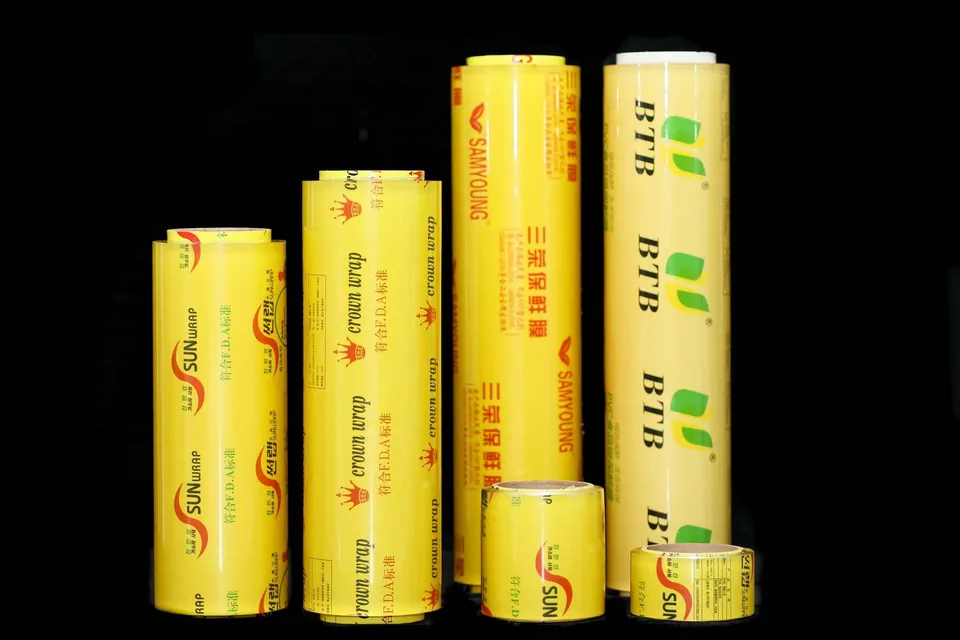
What Is Saran Wrap Made Of?
This is where it gets interesting, because the answer has changed over time.
The original formula: PVDC (1953-2004)
When Dow Chemical launched Saran Wrap in 1953, it was made from PVDC — polyvinylidene chloride. PVDC was originally developed during World War II to protect military equipment from moisture. The material had two exceptional properties that made it perfect for food wrap:
- Natural self-cling — PVDC molecules attract smooth surfaces (glass, ceramic, metal) through molecular polarity, creating a strong seal without any adhesive
- Oxygen barrier — PVDC blocks oxygen transmission 10x better than polyethylene, keeping food fresh significantly longer
For 50 years, this PVDC formula made Saran Wrap the gold standard of plastic food wrap in America.
The modern formula: LDPE (2004-present)
In 2004, S.C. Johnson (which had acquired the Saran brand from Dow) switched the formula from PVDC to LDPE — low-density polyethylene. The reasons:
- Environmental concerns — PVDC contains chlorine, making it difficult to recycle and environmentally controversial
- Cost reduction — LDPE resin costs approximately 40% less than PVDC per kilogram
- Regulatory pressure — growing scrutiny of chlorinated plastics in consumer products
The trade-off was real: LDPE clings significantly less than PVDC. It relies on mild static charge and surface tension rather than molecular attraction. This is why millions of Americans feel that “saran wrap doesn’t stick like it used to” — because it literally is a completely different plastic now.
What commercial cling wrap is made of: PVC
Here is what most consumers do not know: the cling wrap used in supermarket deli counters, meat departments, and commercial kitchens worldwide is made from a third material entirely — PVC (polyvinyl chloride) with food-grade plasticizers.
PVC cling film contains plasticizers (typically DEHA or ATBC — not phthalates) that give it excellent self-cling, crystal clarity, and anti-fog properties. This is the material that still performs the way the original Saran Wrap used to — strong cling on glass, ceramic, stainless steel, and the film itself.
| Material | Used In | Cling Strength | Microwave Safe | Cost (FOB China) |
|---|---|---|---|---|
| PVDC | Original Saran Wrap (1953-2004) | Superior | No | $2.50-4.00/roll |
| LDPE | Modern Saran Wrap, most consumer brands | Moderate | Yes | $1.00-1.40/roll |
| PVC | Commercial deli wrap, supermarket, HORECA | Excellent | No | $0.80-1.10/roll |
Key insight: If you need saran wrap that actually sticks well, commercial-grade PVC cling film from a Chinese manufacturer delivers cling performance comparable to the original PVDC formula — at less than half the cost. SUNWRAP has been producing this formulation since 2004.
Is Cling Wrap the Same as Saran Wrap?
Yes — cling wrap, saran wrap, plastic wrap, and cling film are all names for the same product category. As shown in the terminology table above, the differences are purely regional. The confusion arises because different countries use different names for the identical product, different brands use different materials (PVC vs PE vs PVDC), and the Saran Wrap brand itself changed its material in 2004 — so even the same brand is not the same product it once was. To see how today’s Saran stacks up against Glad, Reynolds and Stretch-Tite on thickness and price per square foot, read our plastic wrap brands compared guide.
For a deeper dive into the naming differences across all seven regions, see our Saran Wrap vs Cling Wrap vs Plastic Wrap comparison guide.
What Is Cling Wrap Made Of? The Three Materials Explained
Whether you call it cling wrap, saran wrap, or plastic wrap, every product on the market is made from one of three plastics. Here is what each one actually is:
PVC (Polyvinyl Chloride) — The Commercial Standard
PVC cling wrap is made from polyvinyl chloride resin compounded with food-grade plasticizers. The plasticizers (typically DEHA — di(2-ethylhexyl) adipate — or ATBC — acetyl tributyl citrate) make the rigid PVC resin soft and flexible, and they are what give the film its characteristic self-cling.
Properties of PVC cling wrap:
- Thickness: 8-15 microns (0.008-0.015 mm)
- Clarity: 92-95% light transmission (crystal clear)
- Oxygen transmission rate: 8,000-12,000 cc/m2/24h
- Cling force: 15-35 N/m depending on thickness
- Temperature range: -20 C to +60 C
- NOT microwave safe (plasticizer migration at high temperatures)
PVC dominates the commercial food-service market because nothing else matches its combination of clarity, cling strength, and low cost. It is the standard material in supermarket meat departments, deli counters, and catering kitchens worldwide.
Food safety: PVC cling film is FDA-compliant for food contact (with approved plasticizers per 21 CFR 178.3740) and safe for cold food contact when manufactured with approved non-phthalate plasticizers. The key restriction is no microwave use and limited contact with hot, fatty, or oily foods. Reputable manufacturers like SUNWRAP provide SGS migration test reports with every export shipment.
PE / LDPE (Polyethylene) — The Consumer Standard
PE cling wrap is made from low-density polyethylene — the same plastic used in grocery bags and squeeze bottles. It contains no plasticizers at all; the polyethylene itself is naturally soft and flexible.
Properties of PE cling wrap:
- Thickness: 10-15 microns (0.010-0.015 mm) — slightly thicker than PVC
- Clarity: 88-92% light transmission (slight milky haze compared to PVC)
- Microwave safe up to 110 C (230 F)
- BPA-free, no plasticizers
- Weaker cling than PVC — relies on static charge
- Recyclable at grocery store film drop-off bins (plastic code #4)
This is what modern Saran Wrap brand and most consumer plastic wrap brands are made from. It is the safer option for home kitchen use, especially when microwave reheating is involved.
PVDC (Polyvinylidene Chloride) — The Original Premium
PVDC was the original Saran Wrap material. It has the strongest natural cling of all three plastics, plus an oxygen barrier approximately 10 times better than PE. But PVDC is expensive (3-4x the cost of PVC), contains chlorine, and is difficult to recycle. It has been largely phased out of consumer products since the early 2000s.
Today, PVDC is still used in some specialty food packaging (multi-layer barrier films for cheese, processed meats, and medical packaging) but rarely in consumer cling wrap.
How Thick Is Saran Wrap?
Saran wrap thickness varies by material type and application. Here is the complete thickness breakdown:
| Product Type | Thickness | Equivalent | Typical Application |
|---|---|---|---|
| Consumer PE wrap (Saran Wrap brand) | 11-12 microns | 0.43-0.47 mil | Home kitchen |
| Consumer PVC wrap | 8-10 microns | 0.31-0.39 mil | Retail boxes, home use |
| Food-service PVC | 12-14 microns | 0.47-0.55 mil | Restaurant, deli counter |
| Meat wrapping PVC | 15-17 microns | 0.59-0.67 mil | Butcher, supermarket meat dept |
| Machine wrapping | 18-20 microns | 0.71-0.79 mil | Automatic tray wrappers |
| Industrial cling film | 22-30 microns | 0.87-1.18 mil | Cold storage, pallet overwrap |
Conversion formula: 1 micron = 0.001 mm = 0.0394 mil. A standard sheet of copy paper is about 100 microns — so saran wrap is roughly 8-12 times thinner than paper.
For buyers sourcing commercially, thickness selection is critical. An 8-micron film costs less per roll but tears more easily during high-speed wrapping. A 15-micron film handles bone-in meat cuts without puncturing but uses nearly twice the material per meter. The complete thickness chart guide covers all specifications with performance data at every gauge.
How Is Saran Wrap Made? The Manufacturing Process
Understanding how saran wrap is made helps buyers evaluate quality differences between suppliers. The process differs slightly between PVC and PE:
PVC cling wrap manufacturing (cast extrusion)
-
Compounding — PVC resin pellets are blended with food-grade plasticizers (DEHA or ATBC), heat stabilizers, and anti-fog additives in precise ratios. The formulation determines cling strength, clarity, and food-safety compliance.
-
Extrusion — The compound is fed into a cast extrusion line where it is melted at 170-190 C and extruded through a flat die onto a highly polished chrome cooling roller (chill roll). The chill roll temperature (15-25 C) controls the film’s clarity and surface finish.
-
Stretching — The film passes through a series of rollers that orient the polymer chains, increasing tensile strength and reducing thickness to the target gauge (8-15 microns).
-
Corona treatment — The film surface is treated with a corona discharge to improve ink adhesion for printed products.
-
Slitting and winding — The wide master roll (1,200-1,800 mm) is slit to finished widths (250-500 mm) and wound onto cores. Consumer rolls are cut to 100-500 meters; jumbo rolls for rewinders run up to 5,000 meters.
-
Quality control — Each production lot is tested for thickness uniformity (±0.5 microns), cling strength, tensile strength, clarity, odor, and food-contact migration. Retained samples are kept for 12+ months.
PE cling wrap manufacturing (blown film extrusion)
PE cling wrap uses a blown film process: LDPE pellets are melted and extruded through an annular die, inflated into a bubble by air pressure, and then collapsed and wound. The bubble ratio controls thickness and mechanical properties. PE lines typically run faster than PVC casting lines but produce film with slightly lower clarity.
Production capacity benchmark: A mid-sized Chinese cling wrap factory operates 3-6 extrusion lines producing 300-800 tonnes per month. SUNWRAP’s Ningbo facility uses multiple casting lines with dedicated cleanroom environments for food-grade production.
Is Saran Wrap Safe?
The safety of saran wrap depends entirely on the material and how you use it:
PE-based saran wrap (consumer brands): Safe for most uses
- Microwave safe up to 110 C — keep wrap at least 2.5 cm (1 inch) from food
- BPA-free and phthalate-free
- No plasticizer migration risk
- FDA-approved for direct food contact including hot foods
- Safe for freezer use down to -40 C
PVC-based cling wrap (commercial): Safe for cold food contact
- Safe for cold food wrapping (deli, refrigeration, fresh display)
- Not microwave safe — plasticizers can migrate into food at high temperatures, especially into fatty or oily foods
- FDA-compliant when manufactured with approved plasticizers (e.g. DEHA per 21 CFR 178.3740)
- Safe for freezer use down to -20 C
- Must be manufactured with non-phthalate plasticizers (DEHA or ATBC) — always request the SGS migration test report from your supplier
Key safety rules
- Check the material type before microwaving — PE is safe, PVC is not
- Keep cling wrap from touching food in the microwave — leave at least 1 inch of clearance
- Do not wrap hot, fatty foods in PVC — plasticizer migration increases with heat and fat content
- Request test reports from your supplier — a legitimate manufacturer will provide FDA compliance documentation and SGS migration test results for every batch
For a detailed PVC vs PE food safety comparison, see our PVC vs PE Cling Film Technical Comparison.
Saran Wrap vs Other Food Storage Options
How does saran wrap compare to alternatives? Here is the honest assessment from a manufacturer’s perspective:
| Option | Best For | Limitations | Cost per Use |
|---|---|---|---|
| Saran wrap / cling film | Quick coverage, visual display, commercial speed | Single use, not eco-friendly | $0.01-0.03 |
| Aluminum foil | Grilling, baking, light blocking | Not transparent, tears on edges | $0.02-0.05 |
| Beeswax wraps | Eco-conscious home use, sandwiches | Not for raw meat, hand wash only | $0.05-0.10 (amortized) |
| Silicone lids | Round bowls and cups | Limited size range, bulky storage | $0.02-0.04 (amortized) |
| Glass containers | Meal prep, long-term storage | Heavy, expensive upfront, takes space | $0.01-0.02 (amortized) |
For commercial food service (supermarkets, restaurants, catering), saran wrap / cling film remains irreplaceable. No alternative matches its combination of:
- Speed of application (a trained wrapper does 500+ trays per shift)
- Transparency (customers see the food)
- Cost per wrap ($0.01-0.03)
- Self-cling seal (no heat, no adhesive, no clips needed)
This is why global PVC cling film consumption continues to grow at 3-4% annually despite the rise of reusable alternatives in the consumer market.
How to Source Saran Wrap Wholesale from China
If you are a distributor, retailer, or food-service operator looking to buy saran wrap in bulk, sourcing factory-direct from China offers 50-70% cost savings over branded alternatives:
| Specification | FOB Ningbo Price | Container Quantity (20GP) |
|---|---|---|
| PVC, 30cm x 300m | $0.80-1.10/roll | ~10,000 rolls |
| PVC, 45cm x 300m | $1.00-1.30/roll | ~8,000 rolls |
| PE, 30cm x 300m | $1.00-1.40/roll | ~10,000 rolls |
| PVC jumbo, 45cm x 1,500m | $3.50-4.50/roll | ~2,500 rolls |
Minimum order: One 20-foot container (18-22 tonnes). Trial orders of 3-5 tonnes available for first-time buyers.
Custom options: Private-label printing (your brand on the box and film), custom widths, custom lengths, multi-language packaging (English, Arabic, Bahasa, Vietnamese, Tagalog, French, Spanish).
Lead time: 15-25 days production + ocean transit (3-5 days to Southeast Asia, 15-25 days to Middle East, 25-35 days to Europe/Americas).
For the full sourcing guide, see Saran Wrap Manufacturer China — Wholesale Guide and How to Find a Reliable Cling Film Supplier.
The Bottom Line: What Is Saran Wrap?
Saran wrap is a thin, transparent plastic food wrap — originally made from PVDC, now mostly made from PE (consumer brands) or PVC (commercial/food-service). The brand name “Saran Wrap” became a generic American term for all plastic food wrap, the same way cling wrap, cling film, and plastic wrap are used interchangeably in other countries.
The material matters more than the name. PVC delivers the best cling for commercial use. PE is safest for home microwave use. And if you are buying at retail prices, you are paying 3-5x what factory-direct costs.
Contact SUNWRAP for factory-direct PVC or PE cling film pricing — the product Americans call saran wrap, the British call cling film, and the Australians call cling wrap. Same product, same factory, same quality — just different names.
Related guides
- Saran Wrap vs Cling Wrap vs Plastic Wrap — full naming comparison with thickness data
- PVC Cling Film — our flagship product, $0.80-1.10/roll FOB
- PE Cling Film — microwave-safe, the same material as modern Saran Wrap
- Cling Film Suppliers Guide — 8 criteria for evaluating suppliers
- Cling Film Manufacturers in China — verified factories vs traders
- PVC Cling Film Thickness Chart — complete specs at every gauge
- Stretch Film vs Cling Film — they are completely different products
SUNWRAP is a Korean-invested cling film manufacturer in Ningbo, China — FDA-compliant, SGS-tested, 20+ years of production. We supply the product known as saran wrap, cling film, plastic wrap, and food wrap to importers in 50+ countries. Request a quote →
Need a cling film quote while you're reading?
Our export team responds within 12 hours with FOB Ningbo pricing. No obligation.
Frequently Asked Questions
What is saran wrap made of?+
Modern Saran Wrap (the S.C. Johnson brand sold in US stores) is made from LDPE — low-density polyethylene. However, the original Saran Wrap (1953-2004) was made from PVDC — polyvinylidene chloride, which had much stronger cling. Commercial cling wrap used in supermarkets and restaurants is typically made from PVC (polyvinyl chloride) with food-grade plasticizers. So 'saran wrap' as a generic term can refer to PVC, PE, or PVDC film depending on the specific product.
Is cling wrap the same as saran wrap?+
Yes — cling wrap and saran wrap are the same product category. 'Saran Wrap' is an American brand name that became a generic term (like Kleenex or Band-Aid). 'Cling wrap' is the generic term used in Australia and New Zealand. 'Cling film' is the British English term. They all describe thin, transparent plastic food wrap. The material underneath may be PVC, PE, or PVDC depending on the manufacturer.
What is cling wrap made of?+
Cling wrap (also called saran wrap, plastic wrap, or cling film) is made from one of three plastics: PVC (polyvinyl chloride) with food-grade plasticizers — the most common material for commercial cling wrap, providing strong self-cling; PE or LDPE (polyethylene) — used in most consumer brands including modern Saran Wrap, microwave-safe; or PVDC (polyvinylidene chloride) — the original premium material, now mostly discontinued due to cost.
Is saran wrap safe for food?+
Yes, when used correctly. PE-based saran wrap (like modern Saran Wrap brand) is microwave-safe and BPA-free. PVC-based cling wrap is safe for cold food contact (deli counters, refrigeration) but should not be microwaved — the plasticizers can migrate into food at high temperatures. Both types are FDA-compliant when manufactured by reputable factories. The key rule: check the material type on the box before microwaving.
Why did saran wrap change its formula?+
S.C. Johnson changed Saran Wrap from PVDC to LDPE in 2004 for two reasons: PVDC contains chlorine (environmental concern), and LDPE is cheaper to produce. The trade-off was significantly weaker cling — which is why consumers commonly complain that saran wrap 'doesn't stick like it used to.' The product literally became a different plastic.
Sourcing cling film and have questions this article didn't answer?
Related articles
Saran Wrap vs Cling Wrap vs Plastic Wrap — They're NOT the Same
Saran Wrap, cling wrap, and plastic wrap look identical but use different plastics (PVC vs PE vs PVDC). One is microwave-safe, one isn't. Factory comparison with thickness data.
PVC Cling Film Thickness Chart & Selection
How thick is saran wrap? 11-12 microns (0.47 mil). Full cling film thickness chart: 8-30 micron ratings for household, deli, meat wrapping & industrial use. Micron-to-mil conversion + factory specs.
PVC Cling Film vs PE Cling Film: Which Should You Import in 2026?
PVC vs PE cling film — performance, food safety, regulation and cost, side by side, plus a market-by-market recommendation for 2026 B2B importers sourcing from China.