
Product Knowledge
Stretch Film vs Cling Wrap: 5 Differences That Matter for Food Safety (2026)
Stretch Film vs Cling Wrap: What’s the Difference and Why It Matters
Stretch film and cling wrap look similar on the shelf — both are transparent, both come on rolls, both cling to things. But they are completely different products engineered for completely different jobs. One wraps pallets; the other wraps food. Confusing the two can cost your business a container-load of product, a regulatory fine, or worse.
This guide explains the five differences that matter most, from a manufacturer that produces food-grade cling wrap and has seen the confusion cause real problems for buyers.
Quick answer: Stretch film = industrial pallet wrap (thick LLDPE, not food-safe). Cling wrap = food wrap (thin PVC or PE, FDA-compliant). Same concept — different products, different materials, different regulatory status. Never substitute one for the other.
The 5 Key Differences at a Glance
| Feature | Stretch Film (Pallet Wrap) | Cling Wrap (Food Wrap) |
|---|---|---|
| Primary use | Securing freight on pallets | Wrapping and preserving food |
| Material | LLDPE with PIB tackifiers | PVC with food-grade plasticizers, or PE |
| Thickness | 15-30+ microns | 8-15 microns |
| Food contact approved | No | Yes (FDA 21 CFR / EU 10/2011) |
| Cling mechanism | Tackifier-based (film-to-film only) | Inherent PVC polarity or PE static (grips bowls, trays, glass) |
| Cost (FOB China) | $1.50-2.50/kg | $2.50-4.00/kg ($0.80-1.10/roll for PVC) |
The naming overlap is the root of the confusion. In some English-speaking markets — particularly Australia and parts of Southeast Asia — “cling wrap” can colloquially refer to both products. In procurement, that ambiguity creates ordering errors. Always specify: food-grade cling film or industrial stretch film.
For how the names saran wrap, cling wrap, cling film, and plastic wrap relate to each other, see our Saran Wrap vs Cling Wrap vs Plastic Wrap terminology guide.
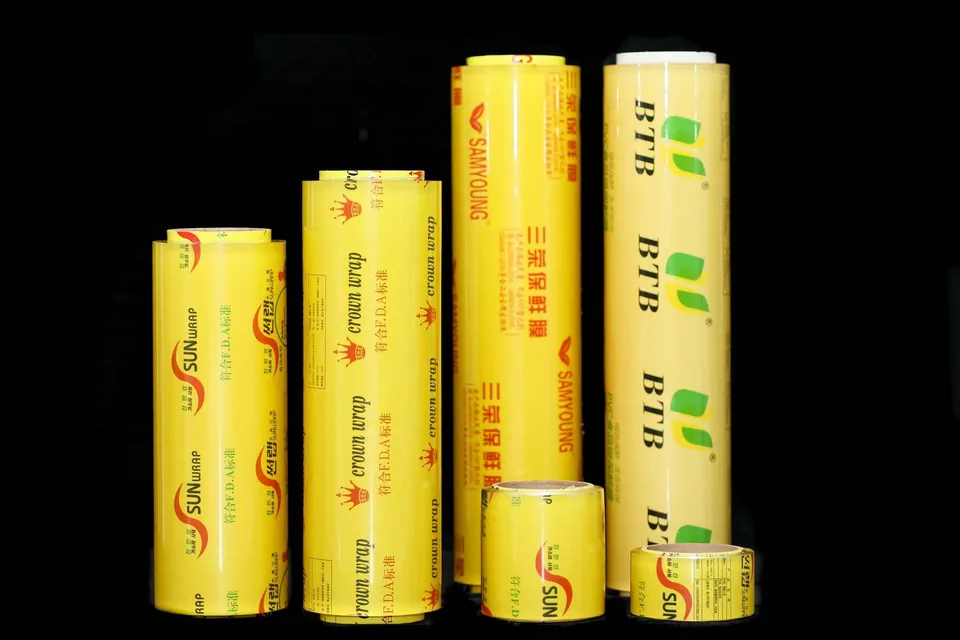
Difference 1: Food Safety Certification
This is the difference that matters most — and the one most often ignored.
Stretch film is manufactured for industrial logistics. The resin formulation includes:
- PIB (polyisobutylene) tackifiers — added to create layer-to-layer cling on the pallet. PIB is not approved for food contact under FDA or EU regulations.
- UV stabilizers — added for outdoor storage of wrapped pallets. Not food-contact approved.
- Slip agents and anti-block additives — engineered for machine dispensing, not food safety.
None of these additives have been tested for migration into food. There are no migration reports, no Certificate of Conformity for food contact, and no FDA compliance documentation.
Cling wrap — whether PVC or PE — is manufactured specifically for direct food contact:
- PVC cling wrap uses food-grade plasticizers (DEHA or ATBC) tested to FDA 21 CFR 178.3740 and EU Regulation 10/2011 migration limits
- PE cling wrap contains no plasticizers at all — the polyethylene itself is inherently food-safe
- Every production lot should come with a Certificate of Conformity and migration test reports
- Factories like SUNWRAP provide per-lot SGS migration testing as standard documentation
The practical risk: If a food inspector finds industrial stretch wrap in contact with food in a commercial kitchen or processing facility, it triggers a non-compliance finding. Depending on jurisdiction, that can mean product disposal, fines, or temporary facility closure.
Difference 2: Thickness and Mechanical Properties
Stretch film and cling wrap are engineered for opposite mechanical goals:
| Property | Stretch Film | Cling Wrap (PVC) | Cling Wrap (PE) |
|---|---|---|---|
| Thickness | 15-30+ microns (hand); 10-20 microns (machine) | 8-12 microns | 10-15 microns |
| Elongation at break | 200-500% | 120-180% | 150-250% |
| Tensile strength | 25-40 MPa | 30-50 MPa | 10-25 MPa |
| Puncture resistance | High (engineered for carton corners) | Low-moderate (designed for food, not sharp edges) | |
| Cling force (self) | 150-400 g/cm | 30-80 g/cm | 15-40 g/cm |
Stretch film’s extreme elongation (200-500%) is what gives it load-holding power. The film is stretched around a pallet under tension, and its elastic recovery pulls the load tight. This is exactly wrong for food wrapping — over-stretched film loses its seal on bowls and trays.
Cling wrap’s controlled elongation (120-250%) allows precise wrapping. You stretch it enough to conform to a container rim, and the film stays put. The material is deliberately engineered to resist over-stretching.
Difference 3: Cling Mechanism
This is the engineering distinction most buyers never think about — but it explains why the products behave so differently.
Stretch film clings through tackifiers. PIB (polyisobutylene) is blended into the LLDPE resin or applied as a surface layer. PIB creates strong film-to-film adhesion (layer cling) but weak adhesion to other surfaces. This is intentional — stretch film needs to grip itself on the pallet but release cleanly from carton surfaces.
PVC cling wrap clings through molecular polarity. The chlorine atoms in PVC create dipole-dipole attractions that bond to smooth surfaces — glass, ceramic, stainless steel, polystyrene trays, and the film itself. This is an inherent property of the PVC polymer enhanced by food-grade plasticizers. No tackifier additives needed.
PE cling wrap clings through static charge and mild surface tension, sometimes enhanced with food-approved tackifier masterbatches. PE cling is weaker than PVC but adequate for home kitchen use and applications where PVC-free is required.
What this means in practice: You can seal a glass bowl with PVC cling wrap and it stays sealed for days in a refrigerator. You cannot do this with stretch film — it would slide off the glass surface because PIB tackifiers do not grip non-film surfaces effectively.
Difference 4: Cost Structure
The cost comparison is not as straightforward as “per kilogram” suggests:
| Cost Metric | Stretch Film | PVC Cling Wrap | PE Cling Wrap |
|---|---|---|---|
| Per kg (FOB China) | $1.50-2.50 | $2.50-3.50 | $2.80-4.00 |
| Per roll (30cm x 300m) | N/A (different format) | $0.80-1.10 | $1.00-1.40 |
| Per square meter | $0.005-0.012 | $0.004-0.008 | $0.006-0.010 |
| Compliance cost per lot | $0 (no testing) | $200-500 (SGS migration test) | $200-500 (SGS migration test) |
On a per-square-meter basis, PVC cling wrap is often cheaper than stretch film because it is thinner (8-12 microns vs 20-25 microns). The regulatory compliance testing adds cost per lot, but for container-load volumes that cost is negligible per roll.
The real cost risk is substitution. Buyers who purchase cheap stretch film for food applications save on raw material but take on regulatory liability that far exceeds the savings.
Difference 5: Application Environments
When to use stretch film
- Pallet unitizing for ocean freight and warehouse storage
- Bundling pipes, lumber, steel profiles, and construction materials
- Securing furniture and appliances during transit
- High-speed machine wrapping at distribution centers
- Cold chain pallet wrap for refrigerated logistics
Never use stretch film for: direct food contact, covering food containers, wrapping meat or produce, any food-service application.
When to use PVC cling wrap
- Supermarket tray wrapping (meat, seafood, produce, deli, bakery)
- Restaurant and hotel kitchen food prep coverage
- Food processing line portion control
- Catering and banquet service
- Retail display food coverage
PVC cling wrap is the standard in commercial food service because it delivers the strongest self-cling on cold, wet surfaces at the lowest cost per wrap. See our PVC cling film product specifications.
When to use PE cling wrap
- Home kitchen use (microwave coverage, refrigerator storage)
- HORECA operations with PVC-free procurement policies
- Markets with PVC regulatory restrictions
- Frozen food coverage (stable at -20C and below)
PE is the default material for consumer-grade plastic wrap sold at retail. See our PE cling film range.
How to Avoid the Substitution Mistake
If you are a food-service buyer, procurement manager, or importer, here is the five-step verification process:
Step 1: Check the product label. Look for “Food Grade,” “FDA Compliant,” or “EU 10/2011.” Industrial stretch film will say “Pallet Wrap” or “Stretch Wrap” — not “Food Wrap.”
Step 2: Ask for documentation. Request the FDA compliance declaration and SGS migration test report. A legitimate food-grade supplier provides these within 48 hours. If a supplier cannot provide migration test reports, do not use their film on food.
Step 3: Check the thickness. If the film is thicker than 15 microns and stretches more than 200%, it is almost certainly industrial stretch film, not food-grade cling wrap.
Step 4: Test the cling. Press the film against a glass bowl. PVC cling wrap grips immediately and holds. Stretch film slides off smooth surfaces because its PIB tackifier is designed for film-to-film cling, not film-to-glass.
Step 5: Verify the price. If a “food wrap” is priced at stretch film rates ($1.50-2.00/kg), investigate further. Genuine food-grade PVC cling wrap with FDA testing costs $2.50-3.50/kg. Cheap pricing may indicate industrial film being relabeled.
What About “Food-Grade Stretch Film”?
The term “food-grade stretch film” does exist, but it is misleading. Products sold under this name are typically:
- PE cling wrap in larger roll formats (500-1,500m rolls)
- LLDPE film manufactured without PIB tackifiers and without non-food-contact additives
- Migration-tested to FDA or EU standards
In other words, “food-grade stretch film” is really just cling wrap — PE food-grade film — in a larger format. The name borrows from industrial stretch film marketing but the product is engineered to food-contact specifications.
When sourcing, always verify the actual compliance documentation rather than relying on the product name.
Sourcing the Right Film from China
SUNWRAP manufactures PVC cling film and PE cling film for food-service applications — not industrial stretch film. Our products are:
- FDA food-contact compliant (21 CFR 177.1580 for PVC, 21 CFR 177.1520 for PE)
- SGS migration-tested per production lot
- Available in 8-15 micron thickness range
- Produced in a food-grade cleanroom facility in Ningbo, China
- Priced from $0.80/roll FOB Ningbo for PVC, $1.00/roll for PE
If your requirement is industrial stretch film for pallets, we can refer you to specialist pallet film manufacturers. We believe buyers deserve honest guidance rather than a product that does not match their application.
Contact our export team to discuss your food wrapping specification, or browse our complete product range.
Related Guides
- Stretch Film vs Cling Film: Key Differences — detailed technical comparison from a manufacturer
- Saran Wrap vs Cling Wrap vs Plastic Wrap — terminology guide across regions
- Food Wrap Materials Compared — PVC vs PE vs PVDC
- PVC Cling Film — our flagship food-grade film, $0.80-1.10/roll FOB
- How to Find a Reliable Cling Film Supplier — 8 evaluation criteria
SUNWRAP is a cling film manufacturer in Ningbo, China — FDA-compliant, SGS-tested, 20+ years of production. We produce food-grade PVC cling wrap and PE cling wrap for importers in 50+ countries. Request a quote →
Need a cling film quote while you're reading?
Our export team responds within 12 hours with FOB Ningbo pricing. No obligation.
Frequently Asked Questions
Is stretch film the same as cling wrap?+
No. Stretch film (pallet wrap) is a thick LLDPE industrial film (15-30+ microns) designed to hold freight on pallets. Cling wrap (also called cling film, saran wrap, or plastic wrap) is a thin food-grade film (8-15 microns) made from PVC or PE, designed for direct food contact. They differ in material, thickness, food-safety approval, cling mechanism, and price. Using pallet stretch film on food is a regulatory violation in most jurisdictions.
Can you use stretch film for food?+
Standard industrial stretch film is not food-safe. It contains PIB tackifiers, UV stabilizers, and slip agents not approved for food contact under FDA 21 CFR or EU 10/2011. A niche product called 'food-grade stretch film' does exist — it is essentially PE cling wrap in larger roll formats, manufactured without non-food-contact additives and with full migration testing. Always verify FDA/EU compliance documentation before any film contacts food.
What is the difference between stretch wrap and cling wrap for food?+
Three critical differences: (1) Food safety — cling wrap is FDA/EU food-contact certified; stretch wrap is not. (2) Thickness — cling wrap is 8-15 microns; stretch wrap is 15-30+ microns. (3) Cling mechanism — PVC cling wrap uses inherent plasticizer-based cling that grips bowls and trays; stretch wrap uses PIB tackifiers that grip only itself, not food containers. Bottom line: cling wrap is engineered for food, stretch wrap is engineered for pallets.
Which is cheaper — stretch film or cling wrap?+
Per kilogram, stretch film is cheaper ($1.50-2.50/kg vs $2.50-4.00/kg for food-grade cling wrap). But per square meter of coverage, PVC cling wrap is often comparable or cheaper because it is much thinner (8-12 microns vs 20-25 microns). A 30cm x 300m roll of PVC cling wrap costs $0.80-1.10 FOB China. The real cost difference is in compliance: food-grade cling wrap includes FDA testing, migration reports, and food-safe packaging — none of which stretch film provides.
What happens if I use stretch film on food by mistake?+
Using non-food-grade stretch film for direct food contact is a food safety violation in the US (FDA), EU, and most national regulations. Industrial stretch film contains tackifiers (PIB) and other additives that are not approved for food contact and can migrate into food. In a commercial setting, this can trigger product recalls, regulatory fines, and liability issues. Even in a home kitchen, it is not recommended — the film was not tested for food-contact migration.
Sourcing cling film and have questions this article didn't answer?
Related articles
Saran Wrap vs Cling Wrap vs Plastic Wrap: PVC, PE & PVDC Compared (2026)
Same product, 3 different plastics. PVC clings hardest (8-12 microns), PE is microwave-safe, PVDC was discontinued in 2004. Full material comparison chart + factory pricing. Get quote →
Food Wrap Materials Compared: PVC vs PE vs PVDC — Cling, Safety & Cost (2026)
PVC clings hardest at $0.80/roll. PE is microwave-safe. PVDC costs 3x more. Side-by-side comparison of all 3 food wrap materials with FDA status, thickness data & bulk pricing. Factory direct →
Stretch Film vs Cling Film vs Cling Wrap: Key Differences (One Isn't Food-Safe)
Stretch film is for pallets, cling film is for food — using the wrong one is a food safety violation. Side-by-side comparison: thickness (15-30 vs 8-15 microns), cling force, FDA status & cost. From a cling film manufacturer.