
Sourcing
Foodservice Film 18 in x 2000 ft: Gauge, Weight & FOB Cost
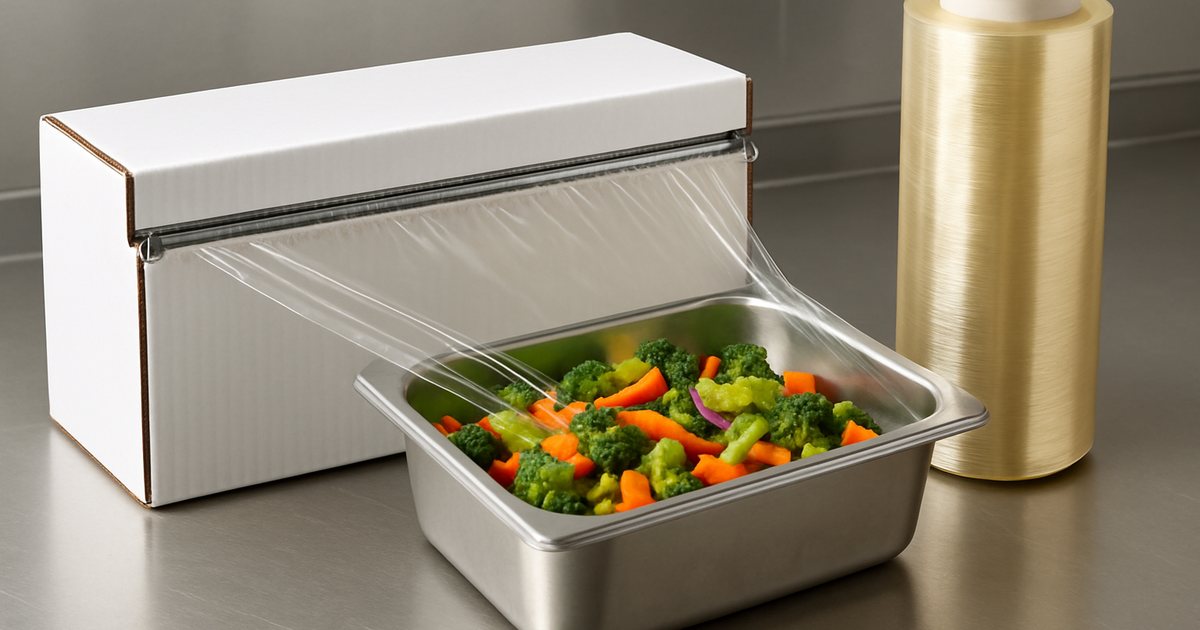
Quick answer: In the US trade, “foodservice film” means clear, high-cling PVC wrap, usually 35 gauge (≈8.9 µm), sold in 12, 18 or 24 in widths × 2,000-3,000 ft, one roll per corrugated cutter box. The workhorse is the 18 in × 2,000 ft roll, which should contain about 3.10 kg (6.8 lb) of film. That one number lets you catch short or thin rolls on a kitchen scale. At the factory gate, that roll costs roughly USD 4.20-6.60 FOB Ningbo, depending on resin price and cutter type. The same format sells for around USD 19-20 a roll from US restaurant supply distributors. Most of the quality complaints we hear about imported foodservice film are really box problems (crushed boxes, rusted blades, rolls blocked by container heat), not film problems.
We manufacture PVC and PE food film at Ningbo Sanrong New Materials in the Ningbo Qianwan New Area, 40 km from Ningbo-Zhoushan port. We have run the same Korean-invested PVC formulation since 2004 and export to more than 50 countries. This guide is written for US distributors, jan-san and restaurant-supply wholesalers, and chain procurement teams who want to import foodservice film rather than buy it through a domestic brand. Competitor listings give you width, length and “35 gauge”. They don’t give you the weight check, box specification, pallet math and cost stack that decide whether an import program works.
What “Foodservice Film” Means in the US Trade
Outside North America, the same product is called catering cling film or HORECA film. It is measured in microns and sold by the metre, as covered in our HORECA cling film guide. US foodservice film differs in three ways that matter when you source it:
- Imperial dimensions. Widths are 12, 18 and 24 in. Lengths are 2,000, 3,000 and sometimes 5,000 ft. A metric 450 mm × 600 m roll is close to 18 in × 2,000 ft but not the same. A 450 mm roll is 7 mm narrower, and 600 m is 1,969 ft. On a price-per-roll comparison that 1.5% gap is invisible until someone measures it.
- Gauge, not microns. US film gauge is hundredths of a mil: 100 gauge = 1 mil = 25.4 µm. Some Middle Eastern and African buyers use “gauge” loosely, so always confirm the unit in writing.
- The box is part of the product. A US foodservice roll ships in its own coated corrugated cutter box, and that box is often the only shipper carton. Box quality drives most of the customer complaints.
| US gauge | Mil | Microns | Typical foodservice use |
|---|---|---|---|
| 35 | 0.35 | 8.9 | Standard film: covering pans, bowls, sheet trays, deli and bakery |
| 40 | 0.40 | 10.2 | Standard-plus: better tear resistance for busy prep lines |
| 50 | 0.50 | 12.7 | Heavy duty: meat, bone-in cuts, stacked storage in walk-ins |
| 60 | 0.60 | 15.2 | Meat and produce film, puncture-critical wrapping |
| 70 | 0.70 | 17.8 | Specialty heavy film, low stretch |
For the full micron-to-mil table across household, supermarket and industrial grades, see our cling film thickness chart.
Standard Sizes, Stations and Net Film Weight
The width follows the pan. Kitchens typically standardise 12 in for small containers and line work, 18 in for full-size hotel pans and half-sheet trays, and 24 in for full sheet pans and bakery racks. The table below gives the film area and the net film weight each size should have. It is calculated from area × thickness × a plasticised PVC density of 1.25 g/cm³.
| Roll size | Film area | Net film, 35 ga | Net film, 50 ga | Main station |
|---|---|---|---|---|
| 12 in × 2,000 ft | 2,000 sq ft / 185.8 m² | 2.06 kg / 4.5 lb | 2.95 kg / 6.5 lb | Line work, small containers |
| 12 in × 3,000 ft | 3,000 sq ft / 278.7 m² | 3.10 kg / 6.8 lb | 4.42 kg / 9.8 lb | High-volume line work |
| 18 in × 2,000 ft | 3,000 sq ft / 278.7 m² | 3.10 kg / 6.8 lb | 4.42 kg / 9.8 lb | Hotel pans, half sheets, deli |
| 18 in × 3,000 ft | 4,500 sq ft / 418.1 m² | 4.65 kg / 10.2 lb | 6.64 kg / 14.6 lb | Commissary, central kitchen |
| 24 in × 2,000 ft | 4,000 sq ft / 371.6 m² | 4.13 kg / 9.1 lb | 5.90 kg / 13.0 lb | Full sheet pans, bakery racks |
Plasticised PVC ranges from about 1.22 to 1.30 g/cm³ depending on plasticiser loading, so allow ±3% on these figures. Anything outside ±5% needs an explanation. For metric roll formats and core options, our cling film roll sizes guide has the equivalent tables.
The Weight Check: Is Your “2,000 ft” Roll Really 2,000 ft?
Short rolls are the most common quiet cheat in cutter-box film. They are hard to catch because nobody unrolls 2,000 ft to count it. You don’t need to. Film is a uniform sheet, so its weight tells you how much you have:
Length (ft) = net film weight (kg) ÷ (width (m) × thickness (µm) × 1.25) × 3,281
For an 18 in, 35-gauge roll that simplifies to about 646 ft of film per kg. Here is how to check a roll in five minutes:
- Weigh the whole roll in its box. Then remove the roll and weigh the empty box.
- Unwind the roll to the core on the last one of a batch you are testing (or buy one sacrificial roll) and weigh the bare core.
- Net film = roll weight − core weight. Compare it with the table above.
A worked example: a sample sold as 18 in × 2,000 ft × 35 gauge holds 2.65 kg of film against the expected 3.10 kg. That is 14.5% less film, equivalent to a 1,710 ft roll. Weight alone can’t tell you whether the roll is short or thin, but a micrometer can. Measure the gauge at five points across the web per ASTM D6988. If it reads 8.9 µm, the roll is short. If it reads 7.6 µm, it is thin and full length. Either way, the price per square foot is 17% higher than it looked.
We publish the target net film weight on every carton label for this reason. Ask any supplier you are evaluating to do the same. A factory that resists printing net weight is telling you something.
Cutter Box Construction: Where Most Complaints Come From
On the kitchen line, the box is the product. The cook never sees a spec sheet. They see a box that goes soft next to the dish pit, a blade that tears instead of cuts, or a roll that falls out of the end panel. These are the specifications that separate a box that lasts the whole roll from one that doesn’t:
| Component | Economy spec | Spec we recommend for export | Why it matters |
|---|---|---|---|
| Board | Uncoated kraft, 32 ECT | White-top board, 44 ECT for floor-loaded containers | Stack strength after 30-45 humid days at sea |
| Coating | None | Grease- and moisture-resistant aqueous or poly coating | Kitchens are wet and greasy. Uncoated boxes delaminate within weeks |
| Serrated blade | Plain carbon steel | Tinplated or coated steel, fully covered by the lid flap | Plain steel rusts in container humidity before the box is opened |
| Slide cutter | None | Enclosed blade on a snap-fit track | Fewer hand cuts; a clean edge on every pull |
| Roll retention | Roll loose in box | End-panel locks or core plugs | Stops the roll jumping out and re-winding on a hard pull |
| Tear strip / lid | Glued flap | Tear-open strip with a re-closing flap | Keeps the film edge clean between uses |
Serrated or slide cutter? Serrated boxes are cheaper and familiar to most independent restaurants. Slide cutters cost us USD 0.20-0.40 more per roll to produce. In the US channel the two often sell at almost the same shelf price. WebstaurantStore lists its Choice standard serrated and SafeCut slide-cutter 18 in × 2,000 ft film side by side, both 35-gauge PVC at around USD 19.49 a roll. For a distributor, the slide cutter is usually the higher-margin SKU, and it is the one chain safety managers ask for.
One board-strength calculation most importers never run: in a floor-loaded 40ft HQ, cutter boxes stack about 17 high. The bottom box then carries roughly 66 kg (145 lb). A 32 ECT B-flute box of this size tests at about 470 lb dry by the McKee estimate. After the standard derating for 80-90% humidity and several weeks under load, that drops to roughly 120-160 lb. That is right at the load, which is why the bottom two tiers of a cheap shipment arrive crushed. Specify 44 ECT, or palletise, or both.
Hot Containers and Blocked Rolls: The Summer Shipment Problem
PVC foodservice film clings because of its plasticiser. Heat makes that plasticiser work harder. In summer, the air inside a steel container on a Ningbo quay or a Gulf of Mexico route can reach 50-60°C for hours at a time. Layers of a high-cling film on a tightly wound roll can then block, meaning they partly fuse to each other. On the customer’s counter, a blocked roll won’t start, tears along the edge on the first pull, or leaves a sticky surface.
This is a formulation and winding question, not a random defect. Three controls prevent it:
- Cling tuned to the use. Maximum cling sells in a demo but blocks first in a hot container. For the trade-off in detail, see our guide to cling force. Foodservice film should sit in the middle of the cling band, not at the top.
- Controlled winding tension. Rolls wound too tight block faster and telescope, meaning the layers slide sideways and the edges no longer line up. We reject rolls with more than 3 mm edge offset.
- A blocking test before loading. Hold a sample roll at 50°C for 24 hours, cool it to room temperature, then check that it unwinds cleanly. Ask your supplier for this result on summer production, and store the film away from ovens and dish machines once it arrives.
Pallet and Container Math for 18 × 2,000 ft Film
Using the common box size of roughly 19.75 × 5.75 × 6 in and a gross weight of about 4.1 kg per 35-gauge roll:
| Loading method | Units | Gross weight | Freight per roll at USD 3,000/container* | Trade-off |
|---|---|---|---|---|
| 48 × 40 in pallet, 16/layer × 9 layers | 144 rolls per pallet | ~590 kg (1,300 lb) | n/a | Forklift-ready for US warehouses |
| 40ft HQ, 20-21 pallets | ~2,900-3,000 rolls | ~12 t | ~USD 1.00-1.05 | Fast unloading, lower crush risk |
| 40ft HQ, floor-loaded | ~5,500 rolls | ~22-23 t | ~USD 0.55 | Half the freight per roll; needs 44 ECT boxes and hand unloading |
| 20ft GP, floor-loaded | ~2,400 rolls | ~10 t | n/a | Trial orders and mixed-SKU programs |
*The freight figure is an example for comparison only. Ocean rates move weekly, so plug in your forwarder’s current quote.
For most distributors taking full containers, floor-load and pay for hand unloading wins on landed cost. That only holds if the boxes are specified for it. Mixed-width programs (12, 18 and 24 in in one container) are routine for us. Our container loading guide covers mixed-SKU plans.
What It Costs: Building the FOB Price From Resin Up
Foodservice film is a commodity wrapped in a box. The honest way to price it is by weight of film plus the box, not by roll. This is the cost stack for a 35-gauge 18 in × 2,000 ft roll, FOB Ningbo, September 2026:
| Cost element | Per roll (USD) | Driver |
|---|---|---|
| PVC film, 3.10 kg at USD 1,100-1,700 per tonne | 3.41-5.27 | PVC resin and plasticiser prices |
| Paperboard core | 0.12-0.20 | Core diameter and wall |
| Coated corrugated cutter box with serrated blade | 0.40-0.70 | Board grade, print, coating |
| Rewinding, sleeve, labour | 0.15-0.30 | Roll length, automation |
| Inland haulage and FOB charges share | 0.05-0.10 | Container fill |
| Total, serrated cutter box | ≈ 4.20-6.60 | |
| Slide cutter instead of serrated | +0.20-0.40 | Enclosed-blade track |
| 50 gauge instead of 35 | +1.45-2.25 | 1.32 kg more film |
Compare that with around USD 19-20 per roll at US restaurant-supply retail. To get from FOB to your landed cost, add ocean freight per roll from the table above, US duty and fees, and inland delivery. Our landed cost and customs guide walks through the calculation.
The film line is the one that moves. Factory-gate PVC film has ranged between RMB 8,000 and 12,000 per tonne (about USD 1,100-1,700) as resin prices shift. For that reason we quote foodservice film with the film weight stated. When resin moves, you can see exactly why the roll price moved. If a quote comes in well below this stack, go back to the weight check, because the usual cause is less film.
US Compliance and Labelling Checklist
Four items belong in every foodservice film purchase file for the US market:
- Food-contact compliance. FDA does not approve films individually. Compliance is formulation-based. Ask for a statement that the resin and every additive are cleared under the applicable 21 CFR provisions, with plasticisers such as DEHA or ATBC under 21 CFR 178.3740. Also ask for a recent third-party migration report and a continuing guaranty under Section 303(c) of the FD&C Act, which many US distributors require from every food-packaging supplier. Our food-grade certification guide lists the documents in full.
- Country-of-origin marking. Imported cutter boxes must be legibly marked with the country of origin (“Made in China”) under 19 CFR Part 134. Put it on the printed box itself, not only on the master carton.
- California Prop 65. The phthalate DEHP is on the Prop 65 list, which is one reason food film uses non-phthalate plasticisers. Ask for a written plasticiser declaration if you sell into California.
- Tariff classification. Plasticised PVC film falls under HTS heading 3920.43. Additional duties on Chinese-origin goods have changed repeatedly, so check the current Chapter 99 provisions on hts.usitc.gov and confirm with your customs broker for the week you ship. Don’t rely on a rate printed in any article, including this one.
Label the box for the user too. Show width, length, gauge, “PVC”, net film weight, “Do not let film touch food in microwave”, and a lot number that traces back to the production shift.
The Spec Sheet to Send Your Supplier
Don’t send a brand name. Send this sheet, filled in with your current film’s measured values:
- Width / length / gauge: e.g. 18 in / 2,000 ft / 35 ga (8.9 µm ±5%)
- Net film weight: 3.10 kg ±3% per roll, printed on the label
- Material and plasticiser: PVC, non-phthalate, compliant with 21 CFR 178.3740
- Elongation / tensile: ASTM D882, with results on the certificate of analysis for every lot
- Cling: mid-band, tested per ASTM D5458, plus a 50°C/24 h blocking test for summer shipments
- Core: material, inner diameter and length matched to the box
- Box: coated white-top board, 44 ECT if floor-loaded, tinplated serrated blade or slide cutter, end-panel roll locks
- Marking: Made in China, lot code, your brand artwork or plain white box with label
- Loading: floor-loaded 40ft HQ or 48 × 40 in pallets at 144 rolls
We can produce stock-spec plain white boxes from 500 cartons, and fully printed private label foodservice film from around 10,000 boxes per design. If you prefer to convert locally, we also ship cling film jumbo rolls for US rewinders. For the base material specification, see our PVC cling film product page, and for broader channel context, our plastic wrap supplier guide.
Related Guides
- HORECA Cling Film Guide: Restaurant & Catering Sourcing
- Cling Film Thickness Chart: Micron, Mil & Gauge
- Private Label Cling Film: OEM & Custom Branding Guide
- Machine Grade Cling Film for Tray Overwrappers
- Food-Grade PVC Cling Film Products
Request a Foodservice Film Quote
Send us your widths, lengths, gauge, cutter type and annual volume, or a photo of the box you buy today. We will reply within 12 hours with an FOB Ningbo quote that shows the net film weight per roll, the box specification and a container loading plan. Sample rolls in 12, 18 and 24 in are available for weight and cling testing before you commit to a container.
Need a cling film quote while you're reading?
Our export team responds within 12 hours with FOB Ningbo pricing. No obligation.
Frequently Asked Questions
What gauge is standard foodservice film?+
Standard US foodservice film is 35 gauge, and heavy-duty or meat film is 50-60 gauge. In the US film trade, 100 gauge equals 1 mil (25.4 microns), so 35 gauge is 0.35 mil or about 8.9 microns, 40 gauge is about 10.2 microns, and 50 gauge is about 12.7 microns. Most 18 in x 2000 ft cutter-box rolls sold to restaurants, delis and bakeries are 35 gauge PVC. Go to 50 gauge for bone-in meat, sharp-edged trays or long walk-in storage where puncture matters more than cost per foot.
How much should an 18 x 2000 foodservice film roll weigh?+
A true 18 in x 2000 ft roll of 35-gauge PVC film has 278.7 square metres of film. At a typical plasticised PVC density of 1.25 g/cm³, that works out to about 3.10 kg (6.8 lb) of net film, not counting the core and box. The same size in 50 gauge is about 4.42 kg (9.8 lb). With a paperboard core and a corrugated cutter box, expect a shipping weight of roughly 4.0-4.3 kg per 35-gauge roll. If the net film weighs meaningfully less, the roll is either short or thinner than stated. Either way you are paying for film you did not get.
Should I stock serrated-cutter or slide-cutter foodservice film?+
Stock both if your customers are mixed, and lead with slide cutters for chain accounts. Serrated metal-blade boxes are the lowest-cost format and what most independent restaurants already use. Slide-cutter boxes have an enclosed blade on a track, which reduces hand cuts and gives a cleaner edge. That matters to multi-unit operators with safety programs. From the factory side, a slide cutter typically adds USD 0.20-0.40 per roll to the FOB price, while US distributor shelf prices for the two formats are often almost identical. So the slide cutter is usually the better-margin SKU for a distributor.
Is PVC foodservice film FDA compliant and microwave safe?+
PVC foodservice film is compliant for food contact when the resin and every additive are cleared under the relevant FDA regulations in 21 CFR, with plasticisers such as DEHA and ATBC falling under 21 CFR 178.3740. FDA does not issue product approvals for film, so ask your supplier for a formulation compliance statement, a recent third-party migration report and a continuing guaranty. On microwaves, PVC film is generally labelled for non-contact use only. It can cover a container while reheating, but it should not touch the food, especially fatty food, because migration rises with temperature and fat content.
How many foodservice film rolls fit in a 40ft container?+
It depends on whether you palletise. With an 18 in x 2000 ft cutter box measuring about 19.75 x 5.75 x 6 in, a 48 x 40 in US pallet takes 16 boxes per layer and 9 layers, which is 144 rolls and roughly 590 kg per pallet. Twenty to 21 pallets in a 40ft HQ gives about 2,900-3,000 rolls. Floor-loaded, the same container takes roughly 5,500 rolls, at around 22-23 tonnes gross. Floor loading nearly halves freight per roll, but you pay for hand unloading at the US warehouse, and the bottom boxes need a stronger board grade.
What is the MOQ for private label foodservice film?+
For plain white cutter boxes with your label or a relabelled master carton, our MOQ starts at 500 cartons. For a fully printed cutter box with your brand artwork, plan on around 10,000 boxes per printed design. That minimum is set by corrugated printing plates and die-cut tooling, not by the film. Lead time is 15-25 days for plain boxes, or 5-7 days of artwork sign-off plus 20-30 days of production for printed boxes. Ocean transit from Ningbo is roughly 14-18 days to Los Angeles/Long Beach and 30-35 days to US East Coast ports.
Can a Chinese factory make Seal-Wrap-type or Reynolds 914-type film?+
Yes. Seal-Wrap and Reynolds 914 are brand names, not material standards. US buyers use them as shorthand for 35-gauge high-cling PVC foodservice film in a cutter box. Any competent PVC film plant can match the specification: gauge, cling, clarity, elongation, roll length and box format. What you cannot copy is the trademark, so private-label film must carry your own brand. The right way to brief a factory is to send the measured spec of the film you use today (net weight, gauge, width, length, core and box dimensions), not the brand name.
Sourcing cling film and have questions this article didn't answer?
Related articles
HoReCa Cling Film: Restaurant & Catering
Complete guide for HORECA buyers sourcing cling film: 300m catering rolls, food service wrap specifications, dispenser compatibility, bulk pricing for restaurants/hotels/catering, and industrial-grade cling for commercial kitchens.
Plastic Wrap Supplier China — FDA-Grade, OEM, $0.80/Roll
Factory-direct plastic wrap from China — FDA-grade PVC & PE food wrap from $0.80/roll FOB Ningbo. OEM label printing, container-load MOQ, 12-hr quote. Compare grades, thickness & roll specs. Free samples available.
PVC Cling Film Thickness Chart & Selection
How thick is saran wrap? 11-12 microns (0.47 mil). Full cling film thickness chart: 8-30 micron ratings for household, deli, meat wrapping & industrial use. Micron-to-mil conversion + factory specs.