
Technical Guides
Machine Grade Cling Film: Specs for Tray Overwrappers
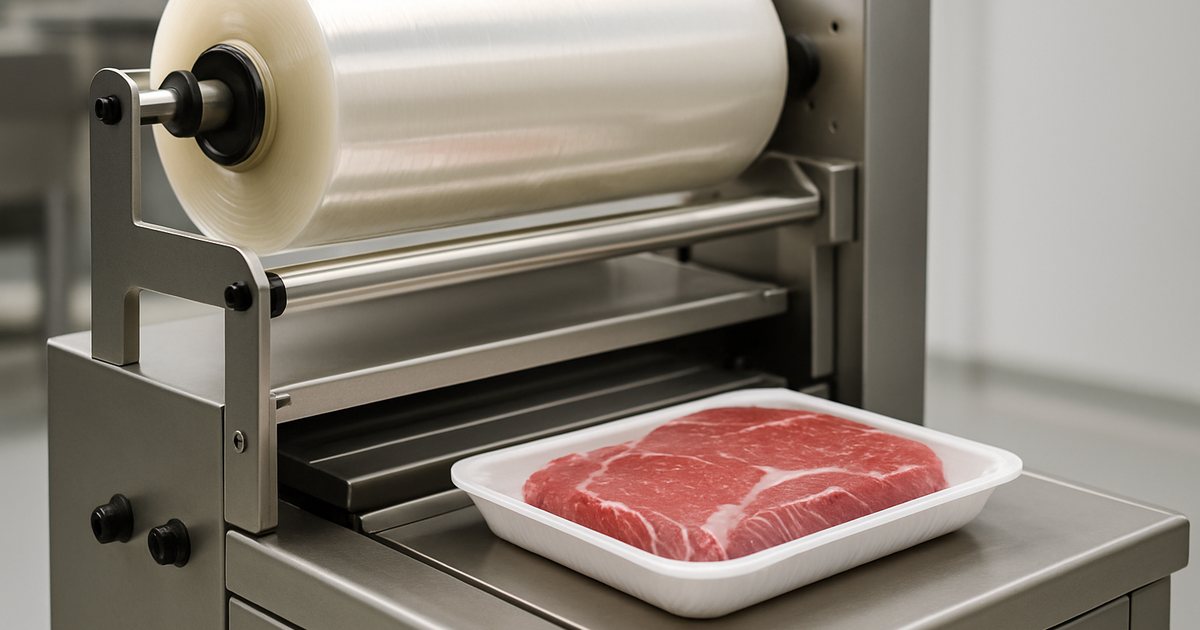
Quick answer: Machine grade cling film and hand-wrap cling film are usually the same polymer and very different products. What separates them is consistency — ±5% thickness tolerance instead of ±10-15%, a controlled coefficient of friction, and cling force tuned to the low end of the usable band so the roll unwinds cleanly at 30-60 packs a minute. Most “the film is bad” complaints on an automatic tray overwrapper trace back to four things: worn PTFE tape on the sealing plate, a plate running 10-20°C too hot, actual gauge below nominal, or a roll whose outer diameter never fitted the machine in the first place. This guide gives you the numbers to specify film that runs, and a fault table to diagnose it when it doesn’t.
We extrude and calender PVC and PE food film in the Ningbo Qianwan New Area, 40 km from Ningbo-Zhoushan port, and have supplied supermarket and food-processing customers in more than 50 countries for over 20 years. This article exists because of a pattern we see constantly: a buyer sources cling film on price per kilo, loads it into an Omori or ULMA or Ilpra overwrapper, gets 8% rewrap rate, and concludes Chinese film is poor quality. Nine times out of ten the film was never specified as machine film. Nobody asked.
Hand-Wrap Film and Machine Film Are Not the Same Product
A person pulling film off a cutter box is a remarkably forgiving machine. They feel the film grab, they slow down, they re-pull, they press the fold with a thumb. An automatic overwrapper does none of that. It applies a fixed unwind tension, a fixed stretch percentage and a fixed plate dwell, thousands of times an hour, and any variation in the film shows up as a reject.
| Hand-wrap film | Semi-automatic film | Full-automatic machine film | |
|---|---|---|---|
| Thickness tolerance | ±10-15% | ±8% | ±5% or tighter |
| Cling force | High — sells on “sticks best” | Medium | Medium-low, tightly controlled |
| COF (film/metal) | Not specified | Loosely specified | Specified and batch-tested |
| Core ID | 1” (25.4mm) | 1” or 1.5” | 1” or 3” (76mm), machine-matched |
| Roll length | 30-300m | 300-600m | 600-1,500m |
| Edge quality | Cosmetic | Important | Critical — edge nicks cause web breaks |
| Typical price premium | Baseline | +1-3% | +3-6% |
That last line is the point of the whole table. Machine grade film is not an exotic material and it does not cost 30% more. It costs a few percent more because it comes off a line that is running tighter process control and a slitter that is being re-bladed more often. If a supplier quotes you machine film at exactly the same price as hand film, they are selling you hand film.
There is one genuine trap here. Buyers who have read that a stickier film performs better — and it does, for hand wrapping, as we covered in our guide to cling force — sometimes specify maximum cling for a machine line. On an overwrapper this backfires. Film that bonds hard to itself on the roll needs a higher unwind torque to release, the higher torque stretches the web before it reaches the tray, and the stretched web then shrinks back off the fold as it cools. You get open packs from film that is too good at clinging.
The Six Numbers Your Overwrapper Actually Cares About
Here is what belongs on a machine-film specification sheet, what to expect, and what breaks when it drifts. Test methods are given because a number without a method is not a specification.
| Property | Method | Typical for PVC overwrap film | What goes wrong if it drifts |
|---|---|---|---|
| Thickness + tolerance | ASTM D6988 / micrometer, 5 points across web | 9-12 µm produce, 12-17 µm meat, ±5% | Thin: burn-through at the plate. Thick: cold seals, film cost up |
| Elongation at break (MD) | ASTM D882 | 150-350% | Low: web breaks on the stretch belts. High: film necks and wrinkles |
| Tensile strength (MD) | ASTM D882 | 40-70 MPa | Low: tears at the folder blade under bone-in trays |
| Peel cling / self-adhesion | ASTM D5458 | 1.5-4.0 N/25mm, controlled band | High: hard unwind, stretch-back, open packs. Low: fold pops |
| Coefficient of friction (film/metal) | ASTM D1894 | Kinetic 0.25-0.45 | High: film grabs the belts and skews. Low: film slips, no stretch |
| Elmendorf tear (TD) | ASTM D1922 | 15-60 g | Low: an edge nick propagates into a full web break |
Two of these are almost never on Chinese quotations unless you ask by name: coefficient of friction and peel cling measured as a band rather than a minimum. Ask for both. A supplier who can produce a COF result to ASTM D1894 has a lab; a supplier who cannot is selling you whatever came off the line.
The other under-specified figure is thickness measured as actual, not nominal. The single most common quality dispute we see is a buyer who ordered 9 micron, received film that measures 7.6-8.2 micron, and cannot understand why the plate temperature that worked for years now burns through. Thinner film is cheaper per square metre, so the incentive to shave gauge is permanent across the industry. Specify a tolerance, specify the method, and check incoming rolls with a micrometer at five points across the web. Our thickness chart guide sets out the micron-to-mil conversions and application bands in full.
Sourcing machine film and want the numbers checked before you commit? Send us your machine model, tray sizes and current fault rate and we will come back with a specification and a trial roll. Talk to the SUNWRAP export team →
Roll Format: The Spec That Silently Kills Orders
Width and length get quoted. Core inner diameter and maximum outer diameter get forgotten, and they are the two that make a container of film unusable on arrival.
| Machine class | Core ID | Roll width | Roll length | Max roll OD |
|---|---|---|---|---|
| Bench-top / manual hot plate | 1” (25.4mm) | 250-400mm | 300-600m | 120-180mm |
| Semi-automatic tray wrapper | 1” or 1.5” (38mm) | 300-450mm | 600-1,000m | 180-220mm |
| Automatic overwrapper (supermarket back-room) | 3” (76mm) | 350-500mm | 900-1,500m | 200-250mm |
| High-speed processing line | 3” (76mm) | 400-600mm | 1,500-3,000m | 250-350mm |
| Jumbo roll for in-house slitting | 3” or 6” (152mm) | 600-1,400mm | up to 5,000m | 400-600mm |
Work the maximum OD backwards before you order. A 450mm × 1,500m roll of 10 micron PVC is roughly 6.5-7 kg and lands near 200mm OD; the same length at 15 micron is closer to 245mm and will not close the film cradle on a machine rated to 220mm. This is arithmetic, not opinion, and it takes two minutes — but it is the reason pallets of perfectly good film sit in warehouses.
Three more format details worth writing into the purchase order:
- Wind direction and core overhang. Specify whether the film pays off over or under the roll, and whether the core is flush or overhangs. Some machines index off the core end.
- Core material. Paper cores absorb humidity in tropical warehouses and go out of round, which shows up as tension surge. Specify a minimum core wall thickness or a plastic core for humid destinations.
- Edge trim. Slit edges must be clean. A single nick in the edge of the web will propagate under machine tension within a few metres. This is where a poorly maintained slitter destroys otherwise excellent film.
For the full width and length matrix across retail, catering and industrial formats, see our cling film roll sizes guide.
The Sealing Plate: Why PVC Dominates Tray Overwrapping
The mechanism of a tray overwrapper is unglamorous and unforgiving. The film is stretched over the tray, four flaps are folded underneath, and the pack is dragged across a heated plate — usually aluminium faced with PTFE tape — which fuses the folds together. Everything about the film has to suit that half-second of contact.
| Material | Working plate temp | Self-cling | Fold retention | Suitability for tray overwrap |
|---|---|---|---|---|
| Plasticised PVC | 120-140°C | Excellent | Excellent — low elastic recovery | Industry default |
| LDPE / LLDPE cling | 95-115°C | Fair | Poor — springs back off the fold | Workable on PE-configured machines only |
| PVDC | 130-150°C | Good | Good | Barrier applications, high cost |
| PLA / compostable | 90-110°C | Poor | Poor — brittle at the fold | Marginal; needs a machine built for it |
PVC wins tray overwrapping for one structural reason: plasticised PVC has very low elastic recovery. Once it is folded, it stays folded long enough for the plate to reach it. Polyethylene wants to spring back. That is why PE performs so well on pallet stretch wrap, where film-to-film locking under continuous tension is the job, and so poorly under a supermarket meat tray. We set out the full material trade-off in PVC vs PE cling film.
Two hard temperature limits are worth committing to memory. Below roughly 105°C the folds do not fuse and packs open in the chiller, typically eight to twelve hours later, which is why the fault gets discovered on the shop floor rather than in the back room. Above roughly 160°C plasticised PVC begins to degrade and evolve hydrogen chloride, which pits the plate, discolours the PTFE tape and can taint product. If your operators are creeping the plate temperature up to fix a sealing problem, the actual problem is almost always elsewhere in the table below.
Troubleshooting: Is It the Film or the Machine?
This is the section our customers actually print out. Run through it in order before raising a claim — and before assuming your machine needs a service call.
| Fault | Most likely cause | Check this first | Film or machine? |
|---|---|---|---|
| Film sticks/burns on the plate | Worn PTFE tape; plate 10-20°C high; gauge below nominal | Replace tape, then drop plate 10°C, then micrometer the film | Machine (usually) |
| Packs open in the chiller | Plate too cool; dwell too short; cling too low | Raise plate 5-10°C in steps; measure peel cling | Both |
| Web breaks mid-run | Edge nick from slitting; unwind tension too high; low tear strength | Inspect roll edges under a light; check Elmendorf figure | Film (usually) |
| Film skews / tracks off | Uneven gauge profile across web; COF too high; belt wear | Micrometer 5 points across web, compare edges to centre | Film (usually) |
| Roll telescopes on the shaft | Poor rewind tension at the converter; soft core | Push-test the roll face; check core roundness | Film |
| Hard unwind, film stretches before the tray | Cling force too high; blocking from hot storage | Check storage temperature; request lower cling band | Film |
| Wrinkles across the tray face | Elongation too high; stretch belts over-tensioned | Reduce stretch %, then check elongation spec | Both |
| Fogging under the film | No anti-fog additive; chiller cycling | Confirm anti-fog masterbatch is in the spec | Film |
| Meat turns brown within a day | Film OTR too low for red meat | Check oxygen transmission rate against spec | Film |
| Static; film clings to machine frame | Low humidity; no antistatic additive | Measure RH in the room; request antistatic grade | Both |
Two of these deserve a note. Blocking from hot storage is a real and underdiagnosed problem for buyers in the Gulf, West Africa and Southeast Asia: plasticised PVC stored above roughly 40°C for weeks will migrate plasticiser to the surface and the roll will unwind much harder than it did at the factory. It is not a manufacturing defect, and it is preventable by storing rolls below 30°C, out of direct sun, and rotating stock within 12 months.
Fogging and browning are film-specification issues, not machine issues, and they are the two most expensive faults on this list because they show up as shrink at the retail counter rather than as rejects in the back room. Anti-fog is a masterbatch decision made at the extrusion stage — it cannot be added later. Oxygen transmission for red meat overwrap needs to be high, not low, which is counter-intuitive to anyone used to barrier packaging; we cover the OTR targets in detail in our ventilated and breathable food film guide and the meat-specific requirements in the meat wrapping guide.
Food-Contact Compliance for Machine Film
Machine film carries one compliance obligation that hand film does not: it is heated. Migration testing is only valid inside the time and temperature conditions it was run under, so a declaration of compliance that covers refrigerated contact does not automatically cover a half-second at 140°C plus a warm fold.
Ask for these, by name:
- Declaration of compliance to EU Regulation 1935/2004 and 10/2011, with the specific migration results for the plasticiser system. DEHA carries a specific migration limit of 18 mg/kg, ATBC 60 mg/kg, ESBO 60 mg/kg, against an overall migration limit of 10 mg/dm².
- US clearance — confirmation that resin and plasticisers fall under 21 CFR 178.3740 and the related food-additive provisions for the intended contact type.
- GMP statement under Regulation EC 2023/2006 covering slitting and rewinding, since that is the step where oil and metal particles are most likely to enter.
- Stated maximum service temperature, and the conditions the migration test was run at. This is the one that is almost always missing.
- For China-facing and re-export business, GB 4806.6 for the resin and GB 9685 for additives.
If a supplier sends a certificate with no test conditions on it, treat it as marketing. Our food-grade certification guide walks through what each document should actually contain.
Cost, MOQ and Lead Time
Straight numbers, FOB Ningbo, at the time of writing:
| Item | Figure |
|---|---|
| Food-grade PVC cling film, FOB Ningbo | USD 1,100-1,700 / tonne |
| Machine-grade specification premium | +3-6% over standard hand-wrap film |
| Anti-fog masterbatch | +2-4% |
| MOQ | 5 metric tons per specification, or one 20ft container for mixed stock SKUs |
| 20ft container capacity, jumbo roll | 16-18 tonnes |
| Lead time, standard specs | 15-20 days |
| Lead time, custom cores / printing / retail packaging | 25-30 days |
| Our monthly capacity | 500+ tonnes |
The premium is small enough that arguing over it is a false economy. Work it from the other end: at 40 packs per minute on a single shift, a one-percentage-point reduction in rewrap rate is worth several thousand trays a month in labour and material. A 4% film premium pays for itself well before that.
Volume changes the sourcing shape. Above roughly 150-200 tonnes a year, buying jumbo rolls and slitting in-house usually beats buying finished machine rolls — you stop shipping air inside cores and cartons, and you gain width flexibility. Below that, converting labour, blade wear and scrap eat the saving. For the container-volume arithmetic behind that decision, see our container loading guide.
How to Write a Spec Your Factory Cannot Misread
Copy this into your RFQ. It takes one email and removes most of what goes wrong.
- Machine make and model, and maximum roll OD the cradle accepts
- Core ID in mm, core wall thickness, wind direction
- Roll width and length, and target roll weight
- Nominal thickness and tolerance — state ±5% and the measurement method
- Peel cling target as a band, e.g. 2.0-3.0 N/25mm to ASTM D5458, not “as sticky as possible”
- COF requirement to ASTM D1894, film-to-metal, kinetic
- Anti-fog: yes/no. Antistatic: yes/no
- Product being wrapped — red meat, poultry, produce, bakery, ready meals — and storage temperature
- Destination market, so the right compliance package is issued
- Plate temperature you currently run, so we can flag a mismatch before shipping
Send the machine model. It is the single most useful line in the whole document, and it is the one buyers leave out most often.
Where to go next
- PVC cling film — the standard material for tray overwrapping, with full specifications
- PE cling film — for machines configured for polyethylene overwrap
- Cling film jumbo rolls — for buyers slitting in-house
- Custom and OEM cling film — bespoke widths, cores, anti-fog and printed packaging
- Cling film price guide 2026 — how resin, plasticiser and freight move the FOB number
Running an overwrapper and fighting your film? Send us the machine model, your tray sizes, your current plate temperature and your reject rate. We will tell you whether it is a specification problem or a machine problem — and if it is the film, we will send a trial roll cut to your machine before you order a container. Request a quote for machine grade cling film →
Need a cling film quote while you're reading?
Our export team responds within 12 hours with FOB Ningbo pricing. No obligation.
Frequently Asked Questions
What is machine grade cling film?+
Machine grade cling film is food wrap engineered to run unattended on an automatic or semi-automatic tray overwrapper rather than to be pulled off a cutter box by hand. Three things separate it from hand-wrap film: a much tighter thickness tolerance, typically ±5% against ±10-15% for hand film, so the machine's film feed does not drift; a controlled coefficient of friction so the film releases from the roll and slides over the stretch belts without grabbing; and a cling force tuned to the low end of the usable band, because a film that clings to itself too hard will not unwind cleanly at 30-60 packs per minute. The polymer is usually the same plasticised PVC. What you pay extra for is consistency, not a different material.
What temperature should the sealing plate be for PVC cling film?+
Most tray overwrappers running plasticised PVC cling film settle between 110°C and 150°C at the plate, with 120-140°C the usual working window and dwell time of roughly 0.4-1.5 seconds depending on machine speed. The correct set point is not a property of the film alone — it depends on plate material, PTFE tape condition, tray height and ambient temperature — so treat any number a film supplier gives you as a starting point and confirm against your machine manual. Two hard limits matter: below about 105°C the fold will not fuse and packs open in the chiller, and above roughly 160°C plasticised PVC starts to degrade and release hydrogen chloride, which corrodes the plate and taints the product.
Can I run PE cling film on a machine set up for PVC?+
Usually not without changing the settings, and often not at all. PE cling film has a lower melting range, roughly 105-125°C for LDPE and LLDPE grades, so a plate set for PVC will melt through it and stick. PE also has far lower self-cling and much higher elastic recovery, so the fold under the tray tends to spring open before the plate reaches it. Machines designed for PE overwrap use different belt tensions and a lower plate temperature. If you are switching materials, ask the machine builder for the PE recipe first, then buy a trial roll — not a container. Our comparison of the two materials covers the wider trade-offs.
What core size and roll dimensions do tray overwrappers use?+
The three common core inner diameters are 1 inch (25.4mm), 1.5 inch (38mm) and 3 inch (76mm). Bench-top and semi-automatic wrappers usually take a 1 inch core; production overwrappers and jumbo-fed lines take 3 inch. Roll widths for tray overwrap run 250mm to 600mm in 50mm steps, with 350mm, 400mm and 450mm covering most supermarket trays. Roll length is typically 300m to 1,500m for finished machine rolls, and maximum roll outer diameter is the constraint most buyers forget — many wrappers cap out at 200-250mm OD, so a 1,500m roll of 9 micron film may physically not fit even though the width is right. Send your machine model and the maximum OD when you request a quotation.
Why does my film keep sticking to the sealing plate?+
In order of frequency: the PTFE tape on the plate is worn or torn, so bare metal touches the film; the plate is 10-20°C too hot, which is the most common single cause after tape wear; the film is thinner than specified, because a 9 micron nominal film running at 7.5 micron actual will burn through at a temperature that was fine last month; or the plasticiser system is migrating, which happens with cheap film that has been stored hot. Replace the tape first, since it costs almost nothing and rules out a third of cases, then drop the plate 10°C, then measure the film thickness with a micrometer at five points across the web before you blame the supplier.
What is the MOQ, price and lead time for machine grade cling film from China?+
Our MOQ is 5 metric tons per specification, or one 20ft container for a mix of stock SKUs — a 20ft container holds roughly 16-18 tonnes of jumbo roll. FOB Ningbo pricing for food-grade PVC cling film sits in the USD 1,100-1,700 per tonne band depending on plasticiser system, thickness and order size, and machine-grade specification with ±5% gauge control and COF testing typically adds 3-6% over standard hand-wrap film. Lead time is 15-20 days for standard widths and thicknesses and 25-30 days when custom core sizes, printed cores or retail packaging are involved.
Should I buy finished machine rolls or jumbo rolls and slit them myself?+
Buy jumbo rolls only if you already run a slitter-rewinder and can hold ±5% gauge and clean edges through the rewind, because a badly rewound roll telescopes on the machine and every one of those faults will be blamed on the film. The economics favour jumbo above roughly 150-200 tonnes per year: jumbo roll costs less per kilo, cuts container volume because you are not shipping air inside cores and cartons, and lets you change widths without changing suppliers. Below that volume the converting labour, blade wear and scrap usually exceed the saving. Our jumbo roll page lists the standard jumbo widths and core options.
Is machine grade cling film food safe, and what documents should I ask for?+
It is food safe when the film is a compliant food-contact material and the machine does not push it outside its validated conditions. Ask for four documents: a declaration of compliance against EU Regulation 1935/2004 and Regulation 10/2011 with specific migration data for the plasticiser system — DEHA carries an 18 mg/kg SML, ATBC 60 mg/kg, against a 10 mg/dm² overall migration limit; for the US market, confirmation the resin and plasticisers are cleared under 21 CFR 178.3740 and related provisions; a GMP statement under Regulation EC 2023/2006 covering the slitting line; and, critically for machine film, the supplier's stated maximum service temperature, because migration testing is only valid inside the conditions it was run at.
Sourcing cling film and have questions this article didn't answer?
Related articles
Cling Film Roll Sizes: 30m-5000m Chart + Pricing
Every standard cling film roll size from 30m household to 5,000m jumbo rewind: outer diameter, core diameter, net weight, pallet count, and wholesale price tiers. Printable reference table — MOQ from 3,000 rolls, factory direct pricing included.
Food Grade Ventilated Stretch Film: Specs, OTR and Sourcing
Ventilated, breathable and perforated food film are three different products. A film manufacturer on OTR targets, micron specs, perforation and how to source each.
PVC Cling Film Thickness Chart & Selection
How thick is saran wrap? 11-12 microns (0.47 mil). Full cling film thickness chart: 8-30 micron ratings for household, deli, meat wrapping & industrial use. Micron-to-mil conversion + factory specs.