
Technical Guides
Cling Film Temperature Range: Freezer to Microwave
Quick answer: A cling film “temperature range” is three different numbers, and most arguments about it come from mixing them up. Mechanically, household wrap survives far more than you would think: on the Japanese labelling test (10 g load, 1 hour in an air oven, 5 °C steps), published ratings are about PVC 130 °C / −60 °C and PE 110 °C / −70 °C. Legally, the limits are much tighter: FDA clears DEHA-plasticized PVC on fatty food only for refrigerated and frozen storage, and the EU covers short heating to 100 °C for no more than 15 minutes under its standard tests. Practically, both films work from a −18 °C freezer to room temperature; microwave use is for PE film labelled for it; the oven is off-limits for all cling film.
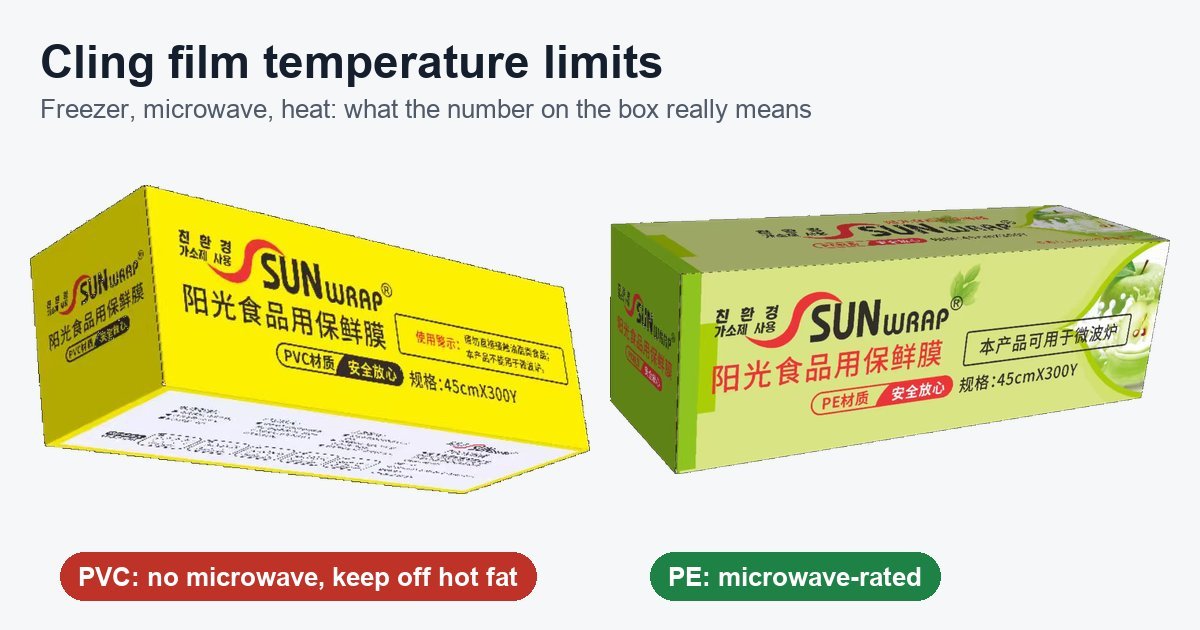
We make PVC and PE food film at Ningbo Sanrong New Materials and print both kinds of box shown below. The PVC box says not for microwave use, do not place in direct contact with oily food. The PE box says can be used in a microwave. This guide explains why we print those two sentences and not a temperature, and which numbers you can safely put on your own private-label pack.
Why One Film Gets Rated Both 60 °C and 130 °C
Search “PVC cling film heat resistance” and you will find 60 °C, 70-80 °C, “melts at 80-100 °C” and 130 °C, sometimes on the same results page. They are not all wrong. They answer different questions:
| What the number measures | Typical figure for PVC food film | Where it comes from | What it is good for |
|---|---|---|---|
| Film survives under light load (no break) | ~130 °C hot / −60 °C cold | Japanese household wrap label test | Knowing the film won’t tear or collapse in a warm kitchen or deep freezer |
| Film starts to feel soft or sag | ~60-80 °C, quoted without a method | Supplier and web guides (60 °C is often decorative cling vinyl sheet, not food film) | Nothing you can specify against |
| Food-contact clearance | Chilled/frozen only for DEHA film on fatty food (US); time-limited heating (EU) | 21 CFR 178.3740 + 176.170(c); EU Regulation 10/2011 Annex V | The number that decides what you may claim |
The first row is a physical property. The third row is about chemistry. A plasticized PVC film can hang intact in a 120 °C oven and still be the wrong film to lay on a hot roast chicken, because the question at that temperature is not whether it breaks but how much plasticizer moves into the fat. Our plasticizer guide covers the migration limits in detail. This article is about temperatures.
The Only Published Test Method for Wrap Temperature Ratings
Most countries do not require a temperature rating on cling film. Japan does, and it is the only place we know of where the test is written down. The Tokyo Metropolitan labelling guideline for food packaging wrap film (in force since 19 April 1977, last amended 1 April 2011) requires eight items on every household wrap box: product name, resin, additives, dimensions, heat-resistant temperature, cold-resistant temperature, usage cautions, and the business name. It also covers boxes marked “for commercial use” if consumers can buy them.
The method, from Annex 1 and Annex 2 of that guideline:
- Specimen: a strip of film about 3 cm × 14 cm, its two ends taped 2.5 cm deep onto paperboard of the same width.
- Heat test: hang the specimen with a 10 g load in an air oven at a set temperature for 1 hour. If it has not broken, raise the oven by 5 °C and repeat. The label shows the highest temperature at which it did not break.
- Cold test: same specimen and load, in a low-temperature chamber for 24 hours. Inspect it immediately, without warming it up, for breaks or visible change, and step down 5 °C at a time. Where lower settings aren’t practical, a −30 °C chamber may be used and the label says “withstands −30 °C”.
Under that method, Kureha, the maker of Krewrap, publishes these typical ratings by material:
| Wrap material | Heat-resistant temp. | Cold-resistant temp. | What it means in use |
|---|---|---|---|
| PVDC (e.g. Krewrap, Saran Wrap Japan) | 140 °C | −60 °C | High barrier, low stretch; the classic Japanese microwave wrap |
| PVC (plasticized) | 130 °C | −60 °C | Highest cling and stretch; our main commercial film |
| PE (single layer) | 110 °C | −70 °C | No plasticizer, lower cling; best cold performance |
| PE/PP 5-layer | 150 °C | −60 °C | Consumer microwave wrap |
| PMP (polymethylpentene) | 180 °C | −30 °C | Oily foods at high heat; tears easily in one direction |
Three things this table does not tell you, and which buyers most often assume it does:
- It is not a microwave rating. The label rules deal with microwaves in a separate caution line: a wrap that cannot be microwaved must say so. That is why a PVC wrap rated 130 °C can still carry “not for microwave use”, as ours does.
- It is not a hot-food rating. A 10 g load in dry air is nothing like hot fat against the film. Oil in a microwave can go well past 100 °C, which is why even PE wraps rated 110 °C carry warnings about fatty foods.
- The cold test is static. The strip hangs still for 24 hours. Nobody unwinds it, cuts it on a serrated blade or stretches it over a frozen tray. A −60 °C rating does not mean the film handles well at −25 °C, and we come back to this below.
Not sure which film fits your temperature profile? Send us the storage temperature, heating step and food type, and we will recommend PVC or PE with the test report to back it. Ask our technical team →
What FDA Actually Clears: Conditions of Use, Not Degrees
US rules do not give cling film a temperature at all. They clear each substance for conditions of use, defined in Table 2 of 21 CFR 176.170(c). The same table is cited in the polyethylene and plasticizer regulations:
| Condition | FDA description | Cling film relevance |
|---|---|---|
| A | High temperature heat-sterilized (e.g. over 212 °F / 100 °C) | Not a cling film use |
| B | Boiling water sterilized | Not a cling film use |
| C | Hot filled or pasteurized above 150 °F (66 °C) | Covering food straight off the stove |
| D | Hot filled or pasteurized below 150 °F | Warm buffet and deli trays |
| E | Room temperature filled and stored | Bakery, dry goods |
| F | Refrigerated storage (no thermal treatment in the container) | Supermarket fresh counter, chiller |
| G | Frozen storage (no thermal treatment in the container) | Freezer |
| H | Frozen or refrigerated ready-prepared foods reheated in the container at time of use | Microwave meals |
Now read the PVC clearance against it. 21 CFR 178.3740 clears di(2-ethylhexyl) adipate (DEHA), the standard cling film plasticizer, at up to 24% of the PVC (film no thicker than 0.005 in) or 35% (no thicker than 0.002 in / 50.8 µm). On fatty foods, both tiers apply only “under conditions of use F and G”, with fat content capped at 30% or 40%. On non-fatty, non-alcoholic foods the clearance sets no condition of use.
So for a US-bound DEHA film, “freezer safe” is directly supported by the regulation, and “microwave safe on fatty foods” is not. That one sentence is worth more than any degree figure you could print.
Polyethylene is treated differently. 21 CFR 177.1520 has a separate entry for polyethylene “used for packing or holding food during cooking” (item 2.2). It caps n-hexane extractables at 2.6% at 50 °C, against 5.5% for general-use polyethylene (item 2.1). A PE film grade that meets the tighter cooking limit has a regulatory basis for heat use that DEHA-plasticized PVC does not. That is the real reason PE, not PVC, is the microwave film. For a side-by-side of the two materials beyond temperature, see our PVC vs PE cling wrap comparison.
What the EU Tests: Time and Temperature Together
EU Regulation (EU) No 10/2011 (we checked the consolidated text dated 16 March 2025) takes a third approach. It sets no rating. Instead, the migration test must match, or exceed, the worst foreseeable time and temperature of use. Annex V, Table 3 gives the standard overall-migration conditions:
| Test | Test condition | Covers |
|---|---|---|
| OM0 | 30 min at 40 °C | Short contact (≤30 min) at cold or ambient temperature |
| OM1 | 10 days at 20 °C | Any frozen and refrigerated contact |
| OM2 | 10 days at 40 °C | Long-term room-temperature storage, incl. hot-fill and heating 70-100 °C within the time formula |
| OM3 | 2 h at 70 °C | Hot-fill or heating 70-100 °C within the time formula, not followed by long storage |
| OM4 | 1 h at 100 °C or reflux | High-temperature use up to 100 °C |
| OM5 | 2 h at 100 °C / reflux, or 1 h at 121 °C | High-temperature use up to 121 °C |
| OM7 | 2 h at 175 °C | High temperature with fatty food beyond OM5 |
The line buyers miss is the heating formula in OM2 and OM3. Heating between 70 °C and 100 °C is covered only for t = 120 / 2^((T−70)/10) minutes. Worked out:
| Food/film temperature | Maximum heating time covered |
|---|---|
| 70 °C | 120 minutes |
| 80 °C | 60 minutes |
| 90 °C | 30 minutes |
| 100 °C | 15 minutes |
Every 10 °C halves the time. A film tested only under OM2 is therefore not covered for a two-hour hot-holding cabinet at 75 °C, even though it may feel like a “low” temperature.
The freezer rule is more generous than people expect. Annex V point 2.1.4(a) says the 10-day, 20 °C test covers all storage times at frozen condition, including freezing and defrosting, as long as labelling keeps the product at or below 20 °C and the total time above −15 °C stays within 1 day. So a film that passes overall and specific migration at 10 days / 20 °C has a sound EU basis for a freezer claim.
Application by Application: Which Film, Which Claim
This is the matrix we use when a distributor asks what to sell to which customer:
| Use | Typical temperature | PVC cling film | PE cling film | Claim you can support |
|---|---|---|---|---|
| Supermarket fresh counter, meat & produce trays | 0-5 °C | ✅ Best choice (cling, clarity, oxygen transmission) | ⚠️ Works, lower cling | ”For refrigerated food” |
| Freezer storage | −18 to −25 °C | ✅ Wrap warm, then freeze | ✅ Best cold handling | ”Freezer safe” (FDA condition G / EU OM1) |
| Room-temperature bakery & dry goods | 20-25 °C | ✅ | ✅ | “For food storage” |
| Covering hot food off the stove | 70-100 °C, short | ⚠️ Non-fatty foods only; keep off fat | ✅ If the grade is tested for it | Only with an OM2/OM3 report inside the time formula |
| Hot-holding (buffet, pass) | ≥63 °C UK / ≥57 °C US, hours | ❌ | ⚠️ Check the test covers the hours | Usually none; use lids |
| Microwave reheating | Can exceed 100 °C at fatty spots | ❌ Not for microwave use | ✅ Loose cover, vented, not touching fat | ”Microwave safe” only on the PE box, with instructions |
| Oven, grill, toaster | 150-250 °C | ❌ | ❌ | “Not for oven use” on every box |
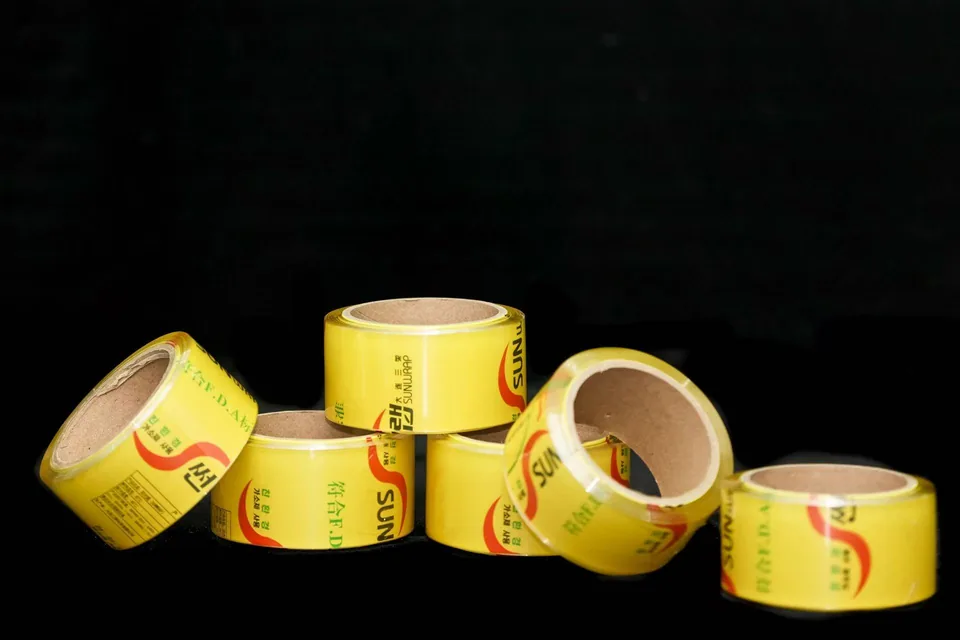
The hot-holding row causes the most complaints in foodservice. UK hot-holding rules require food kept hot to be at or above 63 °C, and the US FDA Food Code sets 57 °C (135 °F). Kitchens then leave film on a tray under a heat lamp for a whole service. That is hours at 60-80 °C, far outside what any standard cling film test covers. If you supply hotels and caterers, our HORECA cling film guide covers the formats they use. The temperature advice is short: film for cold prep and storage, lids for hot-holding.
For fresh red meat, the reason PVC stays on the chiller counter has nothing to do with temperature. It is oxygen transmission and bloom, which we explain in the meat and seafood packaging guide.
Freezer Performance: The Rating Is Not the Problem, Handling Is
No buyer has ever sent us a complaint that film failed at −60 °C. What we do see:
- Film that splits at the cutter. A roll stored in an unheated warehouse in a northern winter, or a cutter box kept in a walk-in freezer, unwinds stiff and tears on the serrated blade. The label test hangs a strip still for 24 hours and never checks this. Keep rolls at 15-25 °C and bring them to room temperature for 24 hours before use. The foodservice cutter box guide covers blade and box choices that help.
- Cling loss on frozen surfaces. Film applied directly to a frost-covered tray does not grip, because the ice layer blocks surface contact. Wrap at chiller temperature, then freeze.
- Thin film tearing on sharp frozen edges. Bones and frozen corners puncture film more easily than temperature does. If your customers freeze whole cuts, going one thickness up is cheaper than rewrapping. The thickness chart maps microns to uses.
A simple incoming check we recommend to importers, since no standard covers it: condition a sample roll at −18 °C for 24 hours, then immediately unwind and cut 20 lengths through the actual cutter. If more than one or two split, specify a softer formulation or a thicker gauge before you place the container order.
Putting Temperature Claims on a Private-Label Box
The artwork stage is where temperature claims go wrong. The rules we apply before approving a customer’s box:
- Every number needs a method. “Heat resistant to 110 °C” with no method is unverifiable, and in Japan it has to follow the prescribed test. If you print a figure, keep the test report on file.
- Separate physical ratings from use instructions. Print the mechanical rating, if you use one, in the spec block. Print what the customer may do (“freezer safe”, “not for microwave or oven use”) as a plain caution line. That is exactly the structure the Tokyo guideline uses.
- Match the claim to the migration report. “Microwave safe” needs a report covering heating (EU OM2/OM3 within the formula, or better). “Freezer safe” needs only the 10-day / 20 °C condition in the EU (overall and specific migration), and FDA condition G for DEHA film on fatty food.
- Keep dimensional tolerance honest while you’re at it. The same Tokyo guideline allows +4% / −2% on printed width and length. Short-length claims draw more retailer chargebacks than temperature claims do.
- Put PVC’s limits in writing. On PVC boxes we print both warnings, “not for microwave use” and “do not place in direct contact with oily food”, in every language on the pack.
Artwork, languages and MOQ for printed boxes are covered in the private label cling film guide and on our custom OEM cling film page. Standard retail boxes start at 500 cartons.
Where This Guidance Runs Out
- Published ratings are typical, not guaranteed. The Japanese figures above come from one manufacturer’s product line. Formulation and thickness move them, so ask for the rating of the film you are actually buying.
- Regulations change and are national. The FDA text cited is current eCFR, and the EU text is the consolidated version of 16 March 2025. China’s GB 4806.7, Japan’s positive list and Gulf standards add their own requirements. Check before you print.
- Microwave ovens do not heat evenly. A film tested at 100 °C can meet much hotter oil at one spot. That is why the safe instruction is about how to use the film (vented, not touching fatty food), not only a temperature.
Related Guides
- Cling Film Plasticizers: DEHA vs ATBC Limits
- PVC Cling Film vs PE Cling Wrap: Complete Comparison for B2B Buyers
- HORECA Cling Film Guide for Restaurants and Caterers
- Cling Film & Saran Wrap Thickness Chart
- PE Cling Film: Specifications and Formats
- PVC Cling Film: Specifications and Formats
Get the Right Film for Your Temperature Profile
Tell us where your film will be used: chiller, freezer, hot-fill or microwave, plus the food type and destination market. We will reply with the PVC or PE grade we recommend, the migration test condition that supports your claim, the box warnings we suggest, and an FOB Ningbo price at your roll size. Jumbo rolls ship from one 20GP container, and PVC and PE can be mixed in the same load.
Need a cling film quote while you're reading?
Our export team responds within 12 hours with FOB Ningbo pricing. No obligation.
Frequently Asked Questions
What is the temperature range of cling film?+
It depends on which temperature you mean. On the mechanical test used for Japanese retail labels (a strip of film under a 10 g load, 1 hour in an air oven, raised in 5 °C steps until it breaks), typical published ratings are PVC 130 °C / −60 °C, PE 110 °C / −70 °C, PVDC 140 °C / −60 °C and PMP 180 °C / −30 °C. Those numbers tell you when the film physically fails. They are not food-contact clearances. For food contact, FDA clears DEHA-plasticized PVC film on fatty food only for refrigerated and frozen storage, and EU Regulation 10/2011 requires the migration test to match the real time and temperature of use. In practice: both PVC and PE film are fine from freezer to room temperature; only a film that the brand has tested and labelled for it should go in a microwave, and no cling film belongs in an oven.
Is cling film microwave safe?+
PE cling film sold as microwave-safe is, when used as the label says: as a loose cover that vents steam and does not touch fatty food. PVC cling film generally should not be microwaved. Our own PVC retail box carries the warning 'not for microwave use, do not place in direct contact with oily food', while our PE box states that it can be used in a microwave. The reason is not that PVC melts at microwave temperatures (on a hanging-strip test it survives well above 100 °C) but that hot fat speeds plasticizer migration, and the US clearance for DEHA on fatty food does not cover heating at all.
Can you put cling film in the freezer?+
Yes. Both PVC and PE cling film are used for frozen storage, and both are cleared for it: FDA condition of use G is 'frozen storage, no thermal treatment in the container', and DEHA-plasticized PVC is cleared on fatty food under exactly that condition. Japanese label tests typically rate PVC wrap to −60 °C and PE wrap to −70 °C, well below a commercial −18 °C freezer. The practical limit is handling, not the rating: film becomes stiffer and tears more easily when it is unwound and flexed at freezer temperature, so wrap the food at chiller or room temperature and then freeze it.
What temperature does PVC cling film melt at?+
PVC food film does not have a single melting point the way the question assumes. It is roughly a quarter to a third plasticizer, and it softens progressively as it warms. On the standard Japanese hanging-strip test, published ratings for PVC household wrap are around 130 °C, meaning a strip under a 10 g load did not break after 1 hour at that air temperature. Web guides that quote 60 °C are often describing thick decorative 'cling vinyl' sheet, a different product. Neither figure is a food-safety limit. For food contact, the binding limit is the regulatory condition of use, which for DEHA film on fatty food in the US is refrigerated or frozen storage only.
Is cling film safe on hot food?+
Covering hot food is a hot-fill condition, and it is regulated separately from cold storage. Under EU Regulation 10/2011, heating between 70 °C and 100 °C is covered by the OM2 and OM3 tests only for a maximum time of t = 120/2^((T−70)/10) minutes: 120 minutes at 70 °C, 60 minutes at 80 °C, 30 at 90 °C and 15 at 100 °C. Under FDA rules, DEHA-plasticized PVC on fatty food is not cleared for any heated condition. For hot-holding in foodservice (at or above 63 °C in the UK, 57 °C under the US FDA Food Code), specify PE film or a lid, and keep film out of direct contact with fatty surfaces.
What temperature ratings should I print on a private-label cling film box?+
Print only numbers your supplier has test reports for, and say which method they come from. If you sell into Japan, the Tokyo Metropolitan labelling guideline for household food wrap requires the material, additives, dimensions (tolerance +4% / −2%), heat-resistant temperature, cold-resistant temperature and microwave instructions, and it prescribes the test method. For other markets, pair a mechanical rating with a plain use statement ('freezer safe', 'not for microwave or oven use') that matches the migration test your Declaration of Conformity actually covers. A number without a method is the most common reason we reject private-label artwork.
Sourcing cling film and have questions this article didn't answer?
Related articles
Cling Film Plasticizers: DEHA vs ATBC Limits 2026
DEHA's EU limit is 18 mg/kg, but the 60 mg/kg total-plasticizer cap is what fails films. Factory guide to DEHA vs ATBC, EU 10/2011 and FDA rules. Get a quote →
HORECA Cling Film Guide: Restaurant & Catering Plastic Wrap Sourcing 2026
Complete guide for HORECA buyers sourcing cling film: 300m catering rolls, food service wrap specifications, dispenser compatibility, bulk pricing for restaurants/hotels/catering, and industrial-grade cling for commercial kitchens.
Private Label Cling Film: Complete OEM & Custom Branding Guide 2026
Complete guide to private label cling film manufacturing: custom printing, color box design, barcode registration, multi-language labeling, artwork requirements, plate costs, lead times, and how to build your own cling film brand from a Chinese factory.