
Sourcing
Cling Film Suppliers: China vs India vs Turkey vs Vietnam
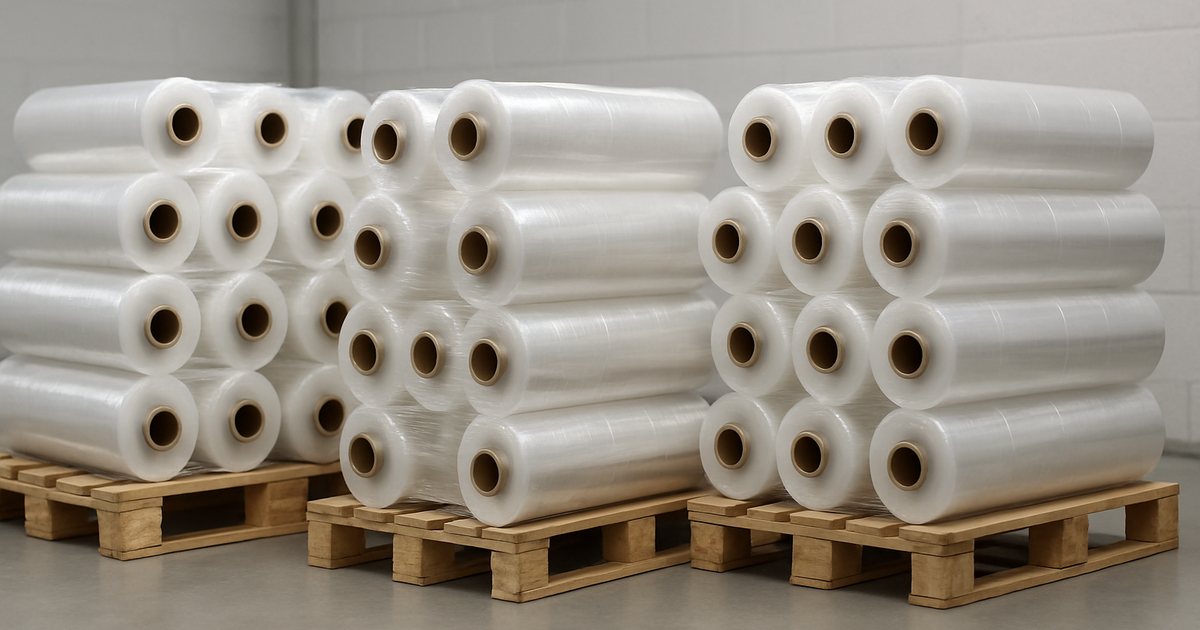
Quick answer: Most “cling film supplier” lists are directory scrapes that put integrated extruders, rewinders and trading companies in one column and rank them by nothing. The useful comparison is by origin and by supplier type. Plasticised PVC food film is concentrated in China, with real secondary capacity in Turkey, India and Taiwan. PE cling and stretch film is spread across China, Thailand, Malaysia, Vietnam, Turkey, Europe and North America. China usually wins on factory-gate price; Turkey often wins on landed cost into the EU because industrial goods of Turkish origin enter at 0% duty instead of 6.5%; Vietnam wins when you need non-China origin for a customer who requires it. Decide on landed cost per destination, not on FOB.
We extrude PVC and PE cling film in Ningbo and have been exporting it for over twenty years. This guide is deliberately not a list of thirty company names. It is the comparison we would want if we were the buyer — including the destinations where we would tell you to look outside China. (If you need a primer on what cling film actually is and how PVC differs from PE, start with our saran wrap vs cling wrap vs plastic wrap explainer.)
The Four Businesses That All Call Themselves “Suppliers”
Search “cling film suppliers” and you get Alibaba, Made-in-China, ThomasNet and a handful of “top 30 manufacturers” articles. Every one of those sources mixes four fundamentally different businesses into a single list. They price differently, they fail differently, and only one of them can change what the film actually is.
| Supplier type | What they control | Typical MOQ | Where they fail |
|---|---|---|---|
| Integrated extruder | Resin compounding, formulation, extrusion, thickness tolerance, cling force | 3-5 MT per spec | Slower on small mixed orders; less flexible on retail packaging |
| Converter / rewinder | Slitting, roll length, cutter boxes, printing, retail packaging | 500-1,000 rolls | Cannot fix a formulation problem — they did not make the film |
| Trading company | Nothing physical; sourcing and paperwork | Often “flexible” | Quality drifts between shipments as they rebook the cheapest factory |
| Stockist / distributor | Local inventory, short lead time, small drops | 1-20 pallets | Price includes their margin; no customisation, no origin control |
The practical rule: if your problem is the film, you need an extruder. If your problem is the roll, a converter is fine. A buyer complaining that the last container did not cling was talking to a converter or a trader — neither of them can raise plasticiser content, because neither of them compounds the resin. We wrote up how that specification actually works in the cling force guide.
There is a fast test. Ask for the plasticiser system and percentage by weight, and the thickness tolerance in microns. An extruder answers in one sentence — “DEHA/ATBC, 24% w/w, ±0.3 micron.” A trading company says it will “check with the factory.”
Where Cling Film Is Actually Made
The single most important fact buyers miss: PVC food film and PE film have completely different supply geographies. Plasticised PVC food film requires calendering or dedicated blown-PVC extrusion plus a food-grade plasticiser compounding capability, and that capacity clustered in East Asia. PE cling and stretch film runs on conventional blown or cast PE lines, which exist everywhere.
| Origin | PVC food film | PE cling / stretch | Indicative FOB, jumbo | Typical lead time | Certification depth |
|---|---|---|---|---|---|
| China (Ningbo, Guangdong, Shandong) | Deep — the global centre | Deep | $1.20-2.00/kg | 15-20 days std, 25-30 custom | FDA, EU 10/2011, Halal, ISO 9001/22000 routinely held |
| Turkey (Istanbul, Gaziantep) | Moderate | Deep | ~12-18% above China | 10-15 days | EU-aligned; strong on EU 10/2011 |
| India (Gujarat, Maharashtra) | Thin for export food film | Deep | Comparable to China on PE | 20-30 days | FSSAI and BIS strong domestically; FDA/EU files less routine |
| Vietnam | Very thin | Growing fast | 5-12% above China on PE | 20-30 days | Improving; EVFTA origin documentation well established |
| Thailand / Malaysia | Thin | Deep, strong on stretch film | 8-15% above China | 20-30 days | Halal certification excellent; strong for Muslim-majority markets |
| EU / North America | Very thin | Moderate, converter-heavy | 2.5-4x China | 5-15 days | Highest, and priced accordingly |
Read that table with one thing in mind. If you are buying plasticised PVC cling film for supermarket trays, your realistic origin choice is China or Turkey, and everything else is a rewinder buying Chinese or Turkish jumbo rolls and reselling them at origin. If you are buying PE cling film or pallet stretch wrap, the field is genuinely open and origin should be decided on duty and freight.
Duty Is the Variable That Reorders the Ranking
This is the part the directory listicles never cover, and it is worth more money than any price negotiation you will run.
Cling film classifies in HS heading 3920. The three codes that matter:
| Product | HS code | Notes |
|---|---|---|
| PVC film, plasticiser ≥ 6% by weight | 3920.43 | Standard food cling film |
| PVC film, plasticiser < 6% | 3920.49 | Rigid and semi-rigid PVC |
| PE film (LDPE/LLDPE) | 3920.10 | PE cling film and pallet stretch wrap |
Indicative third-country rates, which you must confirm against the current tariff schedule before quoting:
| Destination | Rate on 3920.43 | The preference that changes it |
|---|---|---|
| United States (HTS 3920.43.50) | 4.2% general | Additional tariff actions apply to Chinese origin and change frequently — confirm the live stack with your broker |
| European Union | 6.5% third-country | Turkish origin: 0% under the EU-Turkey Customs Union. Vietnamese origin: preferential under the EU-Vietnam FTA with a valid origin declaration |
| United Kingdom | 6.5% | Check the UK-Turkey and UK-Vietnam agreements for your specific code |
| Most of ASEAN | 0-5% | ACFTA gives Chinese origin preference with Form E |
| GCC | 5% common external tariff | Uniform across member states |
Two consequences follow, and both are counterintuitive.
Into the EU, Turkey frequently beats China on landed cost even at a higher FOB. Zero duty instead of 6.5%, plus 3-4 days of trucking instead of 30-35 days of ocean transit and the working capital that ties up. If your customer is in Germany, Poland or Italy and you are buying PE film, quote Turkey.
Into the US, the calculation depends entirely on the current tariff stack on Chinese origin, which is the single most volatile input in this whole guide. That volatility is why buyers ask for Vietnamese or Thai origin — not because the film is better, but because the origin is more predictable. Be aware that requesting non-China origin on PVC food film often produces an offer that is Chinese film rewound in a third country, which is not a change of origin and will not survive a customs audit. Ask where the extrusion happened, not where the roll was packed.
We work through classification evidence and valuation in detail in the HS code 3920 import guide and the full customs and landed-cost walkthrough.
A Worked Landed-Cost Comparison
Take a realistic order: one 40ft HQ of PE cling film jumbo rolls, 13.5 metric tons, delivered to Rotterdam. Cling film is a volume-limited cargo, not a weight-limited one — a 40ft HQ of film weighs 12-15 tonnes against a 26-tonne limit, so you pay for cube.
| Line item | China (Ningbo) | Turkey (Istanbul) |
|---|---|---|
| FOB, 13.5 MT @ jumbo | $19,000 ($1.41/kg) | $22,100 ($1.64/kg, +16%) |
| Ocean / road freight to Rotterdam | $2,400 | $1,900 (road) |
| Insurance | $110 | $120 |
| CIF value | $21,510 | $24,120 |
| Import duty | 6.5% = $1,398 | 0% = $0 |
| Customs clearance, THC, delivery | $650 | $500 |
| Landed cost | $23,558 | $24,620 |
| Per kg | $1.745 | $1.824 |
| Transit time | 30-35 days | 3-5 days |
China still wins this specific case by about 4.5%. But note how thin the gap became — a 16% FOB premium was almost entirely erased by duty and freight — and note what the 4.5% buys you: thirty extra days of inventory financing and thirty extra days of exposure to a specification problem you cannot inspect until it lands. Shift the FOB gap to 10%, or the destination to a country where road freight is shorter, and Turkey wins outright.
Now run the same 40ft into Long Beach and the answer changes again with whatever additional duty is currently in force on Chinese origin. This is why we tell buyers to build the table rather than to ask which country is cheapest. The honest answer from a Chinese factory is: for PVC food film we will usually be your best landed cost anywhere in the world, and for PE film into Europe you should get a Turkish quote alongside ours.
What to Demand Before You Place the Order
Whatever origin you settle on, the verification package is the same. Ask for these five, and check that they agree with each other — inconsistency between documents is more diagnostic than any single document.
- Business licence with manufacturing scope. A Chinese licence states the registered business scope. If it says 销售 (sales) without 生产 (production) for plastic products, you are talking to a trader. Cross-check the unified social credit code against the National Enterprise Credit Information Publicity System.
- Lot-specific migration test report. Not a generic certificate with no lot number. For the US, testing to 21 CFR 177.1580 for PVC and 177.1520 for polyolefins; for the EU, Regulation (EU) No 10/2011, which sets a 10 mg/dm² overall migration limit plus specific limits including 18 mg/kg for DEHA and 60 mg/kg for ATBC. The report must carry the laboratory’s accreditation number. Full detail is in our certification guide.
- Extrusion line list. Make, model, installed year, working width and rated output. Four lines at 600mm working width is a factory; a line list the supplier cannot produce in an hour is not.
- Export record. Bills of lading or export customs declarations showing shipments under HS 3920 to markets comparable to yours. A supplier with no 3920 export history to your region has never dealt with your customs authority.
- Live video walk of the extrusion hall. Not a video file — a live call. Name the production date and ask to see it on the line’s HMI screen and on the roll labels. This one step eliminates most intermediaries in ten minutes.
Five Red Flags We See in Supplier Audits
- “No MOQ” on a custom specification. Custom printing needs plates; custom width needs a slitter setup. A factory always has a minimum. “No MOQ” means they will buy your order off someone else’s stock.
- A cling claim with no test method. “Very sticky” is not a specification. Insist on peel cling per ASTM D5458, with the substrate condition and temperature named, and the figure written into the purchase order.
- A single price for every thickness. Film is sold by weight of resin. If 9, 11 and 13 micron all quote at the same per-roll price, the quote is not built from a cost model and the delivered thickness will float.
- Photographs that appear on three other websites. Reverse-image search the factory photos. It takes ninety seconds and it is the highest-yield check on this list.
- Certificates with no lot number and no laboratory accreditation number. Circulated PDFs are the most commonly recycled document in this trade.
Matching Supplier Type to Your Order Size
Not every buyer should be talking to an integrated extruder. Match the supplier to the volume:
| Your annual volume | Buy from | Why |
|---|---|---|
| Under 5 MT | Local stockist or distributor | Below any factory MOQ; freight and duty overhead swamp the FOB saving |
| 5-20 MT | Converter / rewinder, or a factory trial order | Access to retail formats without custom tooling; expect a 10-15% premium |
| 20-100 MT | Integrated extruder, stock specifications | Full container economics; formulation control on standard SKUs |
| Over 100 MT | Integrated extruder, custom specification | Worth the tooling for custom OEM packaging and a dedicated formulation |
| Converting yourself | Extruder, jumbo rolls | Lowest cost per kg; you add the roll format margin |
If you are still deciding which minimum applies to you, the tier structure is broken down in our MOQ guide, and current price drivers are in the wholesale pricing guide.
Once you have narrowed the origin to China — which is where most PVC food film buyers land — the next question is which factory. We cover the shortlisting process in the cling film supplier sourcing guide and profile the actual production base in the China factory guide.
Commercial Terms, for Reference
So you can benchmark any quote against a real factory rather than a directory listing. Our MOQ is 3-5 metric tons per specification, or one 20ft container for mixed stock SKUs. We extrude food-grade PVC cling film and PE cling film from 8 to 30 microns at ±0.3 micron, in widths from 200mm to 600mm, as retail rolls, food-service rolls and jumbo rolls for rewinders. Lead time is 15-20 days for standard specifications and 25-30 days for custom printing and packaging. We ship FOB Ningbo-Zhoushan and hold FDA, EU 10/2011, Halal and ISO certification, with lot-specific migration reports issued per production run.
We have shipped to more than fifty countries over twenty years, including established programmes in India, Vietnam, the UAE and Nigeria.
Get a Quote You Can Compare
Send us the specification you are buying today — thickness, width, length, roll format, annual volume and destination port. We will return an FOB quote plus the landed-cost calculation for your destination, including the duty line, so you can compare it against your current supplier on the number that actually matters.
If the arithmetic says another origin is better for your destination, we will tell you that too.
Request a quote with landed-cost breakdown · View PVC cling film specifications · View PE cling film specifications
Need a cling film quote while you're reading?
Our export team responds within 12 hours with FOB Ningbo pricing. No obligation.
Frequently Asked Questions
Who are the main cling film suppliers worldwide?+
The supply base splits by material. Plasticised PVC food film — the clingy, crystal-clear film used on supermarket trays — is overwhelmingly made in China, with secondary capacity in Turkey, India and Taiwan. PE cling film and PE stretch film are far more geographically spread: China, Thailand, Malaysia, Vietnam, Turkey, plus Berry Global, Amcor, AEP and Anchor Packaging in North America and Europe. Directory listings on Alibaba, Made-in-China and ThomasNet mix all four supplier types together — integrated extruders, converter-rewinders, trading companies and stockists — which is why a shortlist built from a directory alone is usually 70% intermediaries.
Is China always the cheapest place to buy cling film?+
At the factory gate, usually yes for PVC food film — FOB Ningbo runs roughly $1.20-2.00/kg for jumbo rolls and $6.00-9.00 per 30cm x 300m x 11 micron food-service roll. But FOB price is not landed cost. A Turkish supplier at a 12-18% higher FOB can land cheaper in Germany because industrial goods of Turkish origin enter the EU at 0% under the EU-Turkey Customs Union, versus 6.5% third-country duty, on top of 3-4 days of trucking instead of 30-35 days of ocean transit. Run the landed-cost arithmetic per destination before you decide the origin.
What is the difference between a cling film manufacturer and a supplier?+
Four different businesses use the word supplier. An integrated extruder compounds resin and extrudes film — it controls formulation, so it can change plasticiser content, cling force and thickness tolerance. A converter-rewinder buys jumbo rolls and slits them into retail or food-service rolls — it controls packaging and roll format but not the film itself. A trading company owns no equipment and books production at whichever factory quotes lowest that month, which is why quality drifts between shipments. A stockist-distributor holds inventory locally and sells in pallet quantities. Ask which one you are talking to before you ask for a price.
What HS code is cling film, and what duty will I pay?+
Plasticised PVC film classifies under HS 3920.43 when plasticiser content is 6% or more by weight, and 3920.49 below that threshold. PE cling and stretch film classify under 3920.10. Indicative third-country rates are 4.2% under US HTS 3920.43.50 and 6.5% under the EU and UK tariffs for 3920.43 — but preference schemes change the answer completely: Turkish origin enters the EU at 0% under the Customs Union, and Vietnamese origin claims preference under the EU-Vietnam FTA with a valid origin declaration. Additional US tariff actions on Chinese origin change frequently, so confirm the current stack with your customs broker before you quote a landed price.
What MOQ should I expect from a cling film supplier?+
A genuine PVC extruder will quote 3-5 metric tons per specification, or one 20ft container for a mix of stock SKUs — typically 500-1,000 rolls in a standard size. Custom-printed cutter boxes push the MOQ to 3,000-5,000 rolls because of plate and die setup. Trial orders of 200-300 rolls are possible from most factories at a 10-15% premium. Be suspicious of a supplier quoting no minimum at all on a custom specification: that is a trading company planning to buy your order off someone else's stock shelf.
How do I verify a cling film supplier is a real factory?+
Ask for five documents and check that they agree with each other. One, the business licence, and confirm the registered scope includes plastic film manufacturing rather than trading only. Two, a lot-specific migration test report to FDA 21 CFR 177.1580 or EU Regulation 10/2011 with the laboratory's accreditation number. Three, the extrusion line list with make, model and installed year. Four, an export record — bill of lading copies or customs declarations showing shipments under HS 3920. Five, a live video walk of the extrusion hall where you name the production date and ask to see it on the line's HMI. A trading company can produce documents one and two by borrowing them; it cannot produce four and five.
Sourcing cling film and have questions this article didn't answer?
Related articles
Cling Film MOQ: Minimum Order Guide
Complete MOQ guide for cling film importers: factory minimums for PVC and PE film by product type (retail, jumbo, industrial), private label minimums, how MOQ affects unit price, sample order policies, and strategies for first-time importers with smaller budgets.
PVC Cling Film Supplier: Wholesale Sourcing Guide — Factory vs Trader (2026)
Find a real PVC cling film supplier, not a trader. 8 factory evaluation criteria, China vs India vs Malaysia pricing ($1,100–$1,600/tonne), MOQ 3 tonnes. Red flags that cost importers $15K/container →
Food Grade Cling Film Certification Guide
Complete guide to food-contact certifications for cling film importers: FDA 21 CFR, EU Regulation 10/2011, Halal, Kosher, BRC, ISO 22000 — what you need for each market.