
Technical Guides
Food Grade Ventilated Stretch Film: Specs, OTR and Sourcing
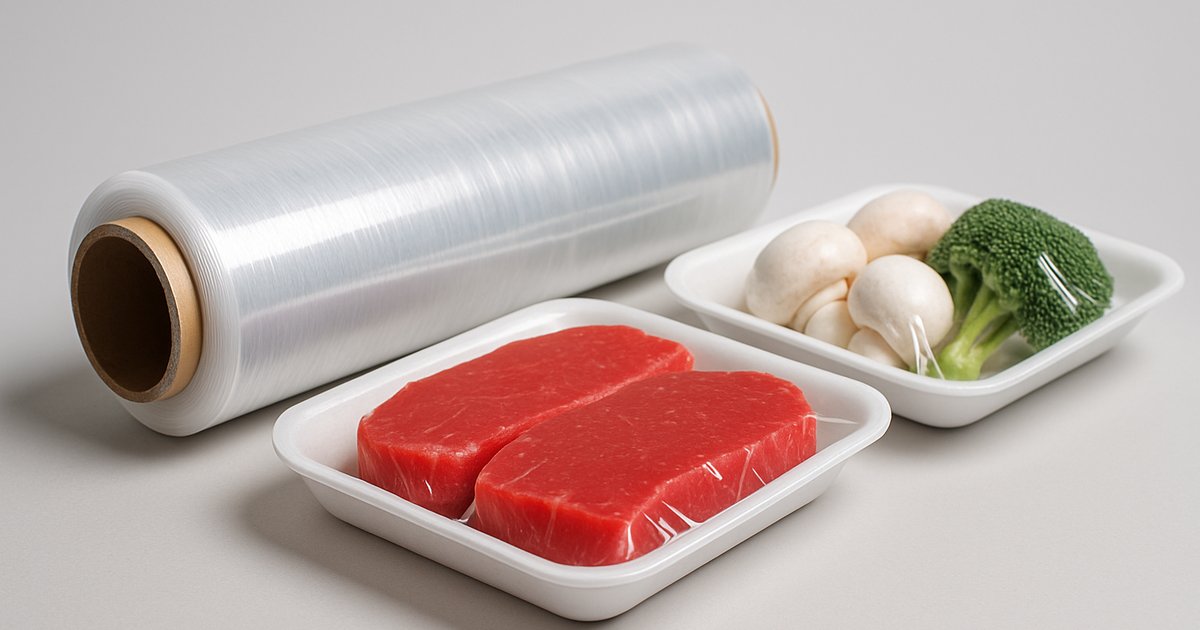
Quick answer: “Food grade ventilated stretch film” is not one product. It is three — high-permeability overwrap film that breathes through the polymer, perforated film that breathes through holes, and vented pallet wrap that is not a food-contact material at all. Choosing between them comes down to one number: how fast your product respires. Below roughly 20 mL CO₂/kg/h a solid high-OTR film is enough. Above it you need perforation, because no food-legal polymer transmits gas fast enough on its own. Get that decision wrong and you either brown your meat, fog your salad, or fail a retailer audit.
We extrude PVC and PE food film in Ningbo and have shipped it to more than 50 countries for over 20 years. The single most common thing that goes wrong on a ventilated-film enquiry is not price and not quality — it is that the buyer and the factory are quoting two different products under the same three words. This guide fixes that first, then gives you the numbers to write a specification that a factory cannot misread.
”Ventilated,” “Breathable,” “Perforated”: Three Films, One Search Term
Start here, because everything downstream depends on it.
| High-permeability overwrap | Perforated / micro-perforated film | Vented pallet stretch wrap | |
|---|---|---|---|
| How it breathes | Through the polymer (dissolution + diffusion) | Through open holes (bulk convection) | Through large punched holes |
| Typical material | Plasticised PVC, LDPE/LLDPE cling | PVC, PE, BOPP, PLA | LLDPE |
| Thickness | 9–17 micron | 15–25 micron | 15–23 micron |
| Hole size | None | 40 µm – 10 mm | 5 – 20 mm |
| Direct food contact | Yes | Yes | No |
| Applied by | Tray overwrapper or hand | Flow-wrapper, lidding, bagging | Pallet wrapper |
| Typical product | Red meat, fish, deli, bakery trays | Mushrooms, broccoli, salad, herbs | Pallets of chilled produce |
| Relative cost | Baseline | +4% to +15% | Baseline (industrial grade) |
Three practical consequences of this table:
- Only the first two are food-contact materials. Vented pallet wrap is an industrial cling film with a completely different additive package. We explain the boundary in detail in stretch film vs cling film.
- “Breathable” without a number is meaningless. A supplier saying “our film breathes” is telling you nothing. Breathability is an OTR figure at a stated thickness, temperature and humidity — or an open-area percentage. Anything else is marketing.
- The machine decides the format. Ask what equipment the film will run on before you argue about microns. A tray overwrapper and a flow-wrapper want different films even for the same tomato.
Why Breathability Is a Shelf-Life Spec, Not a Preference
Fresh food is alive or recently was, and it keeps consuming oxygen and producing carbon dioxide, water vapour and — for fruit — ethylene after packing. The film’s job is to slow moisture loss and keep the product clean without letting the internal atmosphere drift somewhere the product cannot survive.
Three failure modes follow from getting it wrong:
- Anaerobic spoilage. Seal a high-respiration vegetable in a low-permeability film and internal oxygen falls toward zero within hours. The tissue switches to fermentation and produces ethanol and acetaldehyde — the off-flavour and slimy texture in a bag of two-day-old broccoli.
- Condensation and mould. Respiration produces water. A film that blocks water vapour turns a chilled tray into a fog chamber; free water on the surface is the single strongest predictor of mould growth in retail produce.
- Colour loss. For red meat the mechanism is the opposite — too little oxygen, not too much, is what ruins the sale. More on that below.
The variable that decides which film you need is the product’s respiration rate, conventionally reported in mL CO₂ per kg per hour at a stated temperature. The classification used across postharvest literature is worth memorising, because it maps almost one-to-one onto film choice:
| Respiration class | mL CO₂/kg·h at 5 °C | Examples | Film needed |
|---|---|---|---|
| Very low | < 5 | Dates, nuts, dried fruit | Barrier film — breathability is a defect here |
| Low | 5–10 | Apple, grape, citrus, onion, potato | Standard high-OTR overwrap |
| Moderate | 10–20 | Tomato, carrot, cabbage, banana, pepper | High-OTR overwrap, 9–12 micron |
| High | 20–40 | Strawberry, cauliflower, avocado, leek | Micro-perforation recommended |
| Very high | 40–60 | Green onion, snap bean, Brussels sprouts | Micro-perforation required |
| Extremely high | > 60 | Mushroom, broccoli, asparagus, spinach, sweet corn | Macro-perforation or open-vent |
Note the practical cliff at around 20 mL CO₂/kg·h. Below it, polymer permeability can keep up. Above it, it cannot — not for PVC, not for PE, not for any food-legal resin at a usable thickness. That is why mushroom punnets have visible holes and apple trays do not.
Also note temperature. Respiration roughly doubles for every 10 °C rise (a Q₁₀ near 2, and closer to 3 for some leafy crops). A film specified for a 4 °C chiller is under two to four times the gas load if the retailer’s cabinet runs at 12 °C. Specify for the worst case in the actual cold chain, not the design case.
Red Meat: High OTR Is What Sells the Steak
Red meat is the application where ventilated film earns its money, and the chemistry is unusually unforgiving.
Fresh beef surface pigment exists in three states. Deoxymyoglobin is purple-red — the colour of meat straight off the cut. Exposed to abundant oxygen it becomes oxymyoglobin, the bright cherry-red that shoppers read as fresh. Starved of oxygen, or held at a low but non-zero oxygen partial pressure, it oxidises to metmyoglobin, which is brown and reads as old — even when the meat is microbiologically perfect.
That middle condition is the trap. A partial barrier is worse than no barrier at all: it holds oxygen at exactly the low partial pressure that drives metmyoglobin formation. This is why retail overwrap film is specified for extremely high oxygen transmission rather than for barrier.
Patent literature covering retail meat stretch film puts the requirement in hard numbers: a film 0.5 to 1.5 mil thick (approximately 13 to 38 microns) with an oxygen permeability greater than about 1,000 cc per 100 in² per 24 hours, and preferred values above 7,000–10,000 cc/100in²/24h. Converted to metric — 100 in² is 0.0645 m², so multiply by 15.5 — that is roughly 15,500 cc/m²/day at the minimum and 108,000–155,000 cc/m²/day at the preferred level.
Two things follow for anyone writing a purchase order:
- Check the units before you compare quotations. A supplier quoting “OTR 20 cc/m²/day” is quoting a barrier film. A supplier quoting “OTR 20,000 cc/m²/day” is quoting a meat overwrap. Those are the same digits and opposite products, and we have seen the confusion survive all the way to a container arriving at the wrong specification.
- Plasticised PVC is the natural fit. The same plasticiser system that gives PVC food film its cling also opens up the polymer to gas transport, which is why PVC cling film has stayed the dominant retail meat overwrap for four decades despite repeated attempts to displace it. The full application detail is in our PVC cling film meat wrapping guide.
One caution: high OTR extends colour life, not microbial life. Oxygen accelerates lipid oxidation and aerobic spoilage bacteria. Retail overwrap is a two-to-four-day display format at 0–4 °C, not a shelf-life extension technology. Products needing 10+ days go to vacuum skin pack or gas-flushed MAP with a barrier lidding film — a different product line entirely.
Reading an OTR Report Without Being Misled
If you are going to put a breathability number in a contract, you need to know what the number means. Three standards do most of the work:
| Standard | Measures | Why it matters to you |
|---|---|---|
| ASTM D3985 | Oxygen transmission rate, coulometric sensor, dry conditions (23 °C, 0% RH) | The default OTR method. Dry conditions flatter hydrophilic films |
| ASTM F1927 | OTR at controlled relative humidity and temperature | Closer to a real chiller. Ask for this if the product is wet |
| ASTM F1249 | Water vapour transmission rate (WVTR), infrared sensor | Governs fogging and weight loss |
| ISO 15105-2 | OTR, equal-pressure method | The usual European equivalent of D3985 |
Four traps to close in the specification:
- OTR is not a material constant — it scales inversely with thickness. A film with an OTR of 20,000 cc/m²/day at 12 microns has roughly 12,000 at 20 microns. A quotation with an OTR but no thickness is unusable. Insist on both.
- Humidity changes the answer. Dry-condition D3985 results can be materially different from performance at 90% RH inside a meat tray. For wet products, request ASTM F1927 at 23 °C / 90% RH or state the RH you care about.
- Perforated film cannot be meaningfully tested by these methods. Once there are holes, transmission is convective, not diffusive, and a coulometric cell will simply saturate. Perforated film is specified by hole diameter, holes per square metre, and open-area percentage, and validated by a packed shelf-life trial — not by an OTR certificate.
- Ask for lot data, not a type-test. A single certificate from a sample run three years ago tells you what the factory can do on a good day. A per-lot thickness and OTR report tells you what you are buying.
Perforation: Hole Size, Pattern and What It Really Costs
When permeability is not enough, you make holes. There are two industrial routes and they are not interchangeable.
Laser micro-perforation burns holes of roughly 40–200 microns with a CO₂ laser, at densities from a few dozen to a few thousand holes per square metre. Open area is typically below 0.1%. The holes are small enough that insects and most airborne contamination are excluded, and small enough that peel cling is barely affected — the film still runs on a standard tray overwrapper. It is the right choice for salad, berries, herbs and anything where the pack must still look sealed. Cost impact: +8% to +15% on the film price, driven by a separate converting pass and laser tooling amortisation.
Mechanical macro-perforation punches 1–10 mm holes with a needle or pin roller. Open area typically runs 0.5–2%. It is cheap, fast and appropriate for mushrooms, broccoli and bakery products where the gas load is enormous and pack integrity is not the point. Cost impact: +4% to +8%. The tradeoff is real: needle rollers leave a raised burr around each hole that holds the film off the substrate, and we measure 15–30% loss of effective peel cling on macro-perforated film versus the same film unperforated. If your customer complains that the perforated film “doesn’t stick like the old one,” this is why — and the answer is to move to laser micro-perforation, not to add tackifier.
Vented pallet stretch wrap sits outside both categories: 5–20 mm holes in 15–23 micron LLDPE, designed so a pallet of pre-cooled produce can keep exchanging air with the cold room. It is an industrial film. It is not food contact. Do not let it into a food-contact quotation.
A specification for perforated film should name five things: hole diameter, hole pitch or holes/m², open-area percentage, perforation pattern (full-web, banded, or window), and which face carries the burr.
Machine, Roll and Format: The Part Buyers Forget
The film has to run. In practice this decides more of your specification than the polymer does.
- Automatic tray overwrappers (the machines behind a supermarket butchery) want consistent gauge, controlled cling and a specific core. Typical film: 350–500 mm wide, 9–15 micron, on a 76 mm (3-inch) core. Gauge variation above about ±0.5 micron causes tracking faults and film breaks.
- Hand wrapping in a deli or catering kitchen tolerates more variation but wants body: 300–450 mm, 12–17 micron, in cutter-box or dispenser-box format.
- Flow-wrappers and lidding lines need micro-perforated film with a defined seal layer and a running direction; the perforation pattern must be registered so holes do not fall in the seal.
- Rewinders and converters buy jumbo rolls — typically 200–600 mm wide, up to 2,000 metres, which they slit into retail rolls under their own brand.
We produce food film from 8 to 30 microns at ±0.3 micron gauge tolerance, in widths from 200 mm to 600 mm. Full dimensional detail is in our cling film roll sizes guide, and for private-label programmes, custom OEM cling film covers printing, box tooling and artwork.
The Specification Checklist
Copy this into your enquiry. A factory that can answer all nine lines is a factory that has made this film before.
- Product and respiration class — “chilled sliced mushroom, extremely high respiration, packed 250 g in a PET punnet”
- Breathing mechanism — polymer permeability, laser micro-perforation, or mechanical macro-perforation
- OTR target with conditions — “minimum 20,000 cc/m²/day at 12 micron, ASTM D3985, 23 °C” — or, for perforated film, holes/m² and open area
- WVTR target — ASTM F1249, with a fogging acceptance criterion
- Thickness and tolerance — “12 micron ± 0.3 micron, per-lot report”
- Cling requirement — “peel cling per ASTM D5458 minimum 20 N/m at 4 °C, measured after perforation”
- Format — width, roll length, core diameter, winding direction, box type
- Compliance — EU 1935/2004 + 10/2011 declaration with SML data (DEHA 18 mg/kg, ATBC 60 mg/kg, 10 mg/dm² overall), relevant 21 CFR clearances including 178.3740 for plasticisers, GMP statement under EC 2023/2006
- Validation — a packed shelf-life trial at the buyer’s real cabinet temperature before container approval
Line 6 is the one buyers most often omit, and the one that generates the most complaints after delivery. Cling must be specified after perforation, because that is the film your customer actually uses. Our full breakdown of cling as a measurable property is in the stickiest cling film guide, and certification documentation is covered in the food grade certification guide.
Three Sourcing Mistakes We See Every Year
Specifying barrier when you needed breathability. A buyer copies an OTR figure from a cheese-film datasheet into a meat-film enquiry. The container arrives, the meat browns in the cabinet within 24 hours, and the retailer delists the line. Always check whether the number you are copying came from a barrier application.
Testing at the wrong temperature. A film validated in a 20 °C laboratory against a product that ships at 4 °C. Both permeability and cling fall as temperature drops — cling by 30–40% between 23 °C and 4 °C. Run the trial in the chiller that the product will actually sit in.
Buying perforation you do not need. Perforation costs money, kills the moisture barrier and reduces cling. For anything in the low or moderate respiration classes, a well-specified high-OTR solid film is cheaper, stickier and performs better. We talk perhaps a third of enquiries for perforated film back down to a standard food grade cling film after asking what the product actually is.
Commercial Terms
For reference when you are budgeting: our MOQ is 5 metric tons per specification, or one 20ft container for mixed SKUs — a 20ft container holds roughly 16–18 tonnes of jumbo roll. Standard lead time is 15–20 days for unperforated specifications and 25–30 days where perforation, custom hole patterns or printed retail packaging are involved. We ship FOB Ningbo-Zhoushan, and we have been exporting food film for over 20 years to more than 50 countries. Broader market and sourcing context sits in our supermarket cling film sourcing guide and the wider food packaging film range.
Get a Breathability Test Sample
If you are specifying ventilated film for a meat, produce or bakery programme, we will send a comparison sample set: high-OTR PVC at 10, 12 and 15 microns, PIB-tackified PE at 11 microns, and laser micro-perforated film at 20 microns — with the measured thickness, OTR conditions and post-perforation cling stated on each pack, so you can verify our numbers instead of trusting them.
Then run the only test that settles it: pack your actual product, hold it in your actual cabinet, and photograph it at 24, 48 and 72 hours. If our film does not hold colour and clarity better than what you buy today, we will tell you so.
Request a ventilated film sample set · View PVC cling film specifications · View PE cling film specifications
Need a cling film quote while you're reading?
Our export team responds within 12 hours with FOB Ningbo pricing. No obligation.
Frequently Asked Questions
What is food grade ventilated stretch film?+
The term covers three genuinely different products that buyers confuse constantly. First, high-permeability overwrap film — plasticised PVC or low-density PE cling film at 9-17 microns that breathes through the polymer itself, used on supermarket meat and produce trays. Second, perforated or micro-perforated film, which breathes through physical holes from 40 microns to 10mm, used for respiring produce like mushrooms, broccoli and salad. Third, vented pallet stretch wrap — macro-perforated LLDPE at 15-23 microns for wrapping pallets of chilled produce, which is not a food-contact material at all. Specify which one you mean before requesting a quotation, because the price, the certification and the machine are all different.
What oxygen transmission rate do I need for red meat overwrap?+
High — far higher than most buyers expect. Fresh red meat needs abundant oxygen at the surface to convert myoglobin to oxymyoglobin, the bright cherry-red pigment shoppers read as freshness. Patent literature covering retail meat stretch film specifies an oxygen permeability greater than 1,000 cc per 100 square inches per 24 hours, with preferred values above 7,000-10,000 cc/100in2/24h, equivalent to roughly 15,500 to 155,000 cc/m2/day. A barrier film in this application turns the surface brown within a day. Ask your supplier for an OTR figure measured to ASTM D3985 with the thickness, temperature and relative humidity stated alongside it.
What is the difference between breathable film and perforated film?+
Breathable film transmits gas through the polymer by dissolution and diffusion — the film is solid, and permeability is set by the resin, the plasticiser level and the thickness. Perforated film transmits gas through open holes, so the flow is bulk convection and the film material barely matters. The practical difference is magnitude: perforation can raise effective gas exchange by one to three orders of magnitude over a solid film, which is why anything with a respiration rate above about 20 mL CO2/kg/h needs holes, not chemistry. Perforation also destroys the moisture barrier, which is exactly what you want for mushrooms and exactly what you do not want for cheese.
Does perforating the film ruin the cling?+
It reduces it, and how much depends on the hole geometry. Laser micro-perforation at 40-200 microns removes so little surface area — typically under 0.1% open area — that peel cling drops by only a few percent and the film still runs on a standard tray overwrapper. Mechanical macro-perforation with needle rollers at 1-10mm holes removes 0.5-2% of the area, creates raised burrs around each hole that hold the film off the substrate, and can cut effective cling by 15-30%. If you need both strong cling and high venting, specify laser micro-perforation and accept the higher tooling cost.
Is ventilated stretch film food safe, and what certification should I ask for?+
It is food safe only if the base film is a compliant food-contact material and the perforation step does not contaminate it. Ask for three documents. One, a declaration of compliance against EU Regulation 1935/2004 and Regulation 10/2011, with specific migration data for the plasticiser system — DEHA carries an 18 mg/kg specific migration limit and ATBC 60 mg/kg, against a 10 mg/dm2 overall migration limit. Two, for the US market, confirmation that the resin and plasticisers are cleared under the relevant 21 CFR provisions, including 21 CFR 178.3740 for plasticisers. Three, a GMP statement under Regulation EC 2023/2006 covering the slitting and perforating line, since that is where oil and metal particles are most likely to be introduced.
What thickness should ventilated food film be?+
For supermarket tray overwrap on an automatic wrapper, 9-12 microns for produce and light trays and 13-17 microns for meat and bone-in cuts, where puncture resistance matters more than film cost. For hand-wrapping in a deli or butchery, 12-15 microns gives enough body to handle without tearing. For micro-perforated produce lidding, 15-25 microns, because the film must survive the perforation step without splitting. For vented pallet wrap, 15-23 microns of LLDPE. Thinner film is not automatically cheaper per pack: below about 9 microns, breakage and rewrap rates on a fast wrapper usually cost more than the resin saved.
What are the MOQ, price and lead time for ventilated food film from China?+
Our MOQ is 5 metric tons per specification, or one 20ft container for mixed SKUs, and one 20ft container holds roughly 16-18 tonnes of jumbo roll. Plain high-permeability PVC or PE food film sits at the standard cling film price level; laser micro-perforation typically adds 8-15% and mechanical macro-perforation 4-8%, because perforation is a separate pass with its own tooling and scrap. Lead time is 15-20 days for standard unperforated specifications and 25-30 days when perforation, custom hole patterns or printed retail packaging are involved. We ship FOB Ningbo-Zhoushan.
Can I use vented pallet stretch wrap on food trays to save money?+
No. Vented pallet stretch wrap is engineered for film-to-film locking on a pallet load and carries slip, UV and processing additives that are not cleared for direct food contact. Its 5-20mm holes are sized for airflow through a whole pallet, not for controlling the atmosphere inside a 400 gram tray. Using it against food is a compliance failure that will be found in a retailer audit. If a supplier offers you food wrap at pallet-wrap pricing, check which product you are actually being quoted.
Sourcing cling film and have questions this article didn't answer?
Related articles
Food Grade Cling Film Certification Guide
Complete guide to food-contact certifications for cling film importers: FDA 21 CFR, EU Regulation 10/2011, Halal, Kosher, BRC, ISO 22000 — what you need for each market.
PVC Cling Film for Meat Wrapping — Guide
Complete guide to PVC cling film for meat wrapping in butcher shops and supermarkets. Covers film thickness, cling performance, food safety certifications, overwrap vs stretch wrap, and bulk sourcing from China manufacturers.
PVC Cling Film Thickness Chart & Selection
How thick is saran wrap? 11-12 microns (0.47 mil). Full cling film thickness chart: 8-30 micron ratings for household, deli, meat wrapping & industrial use. Micron-to-mil conversion + factory specs.