
Industry Guide
When Was Cling Film Invented? UK & World Timeline
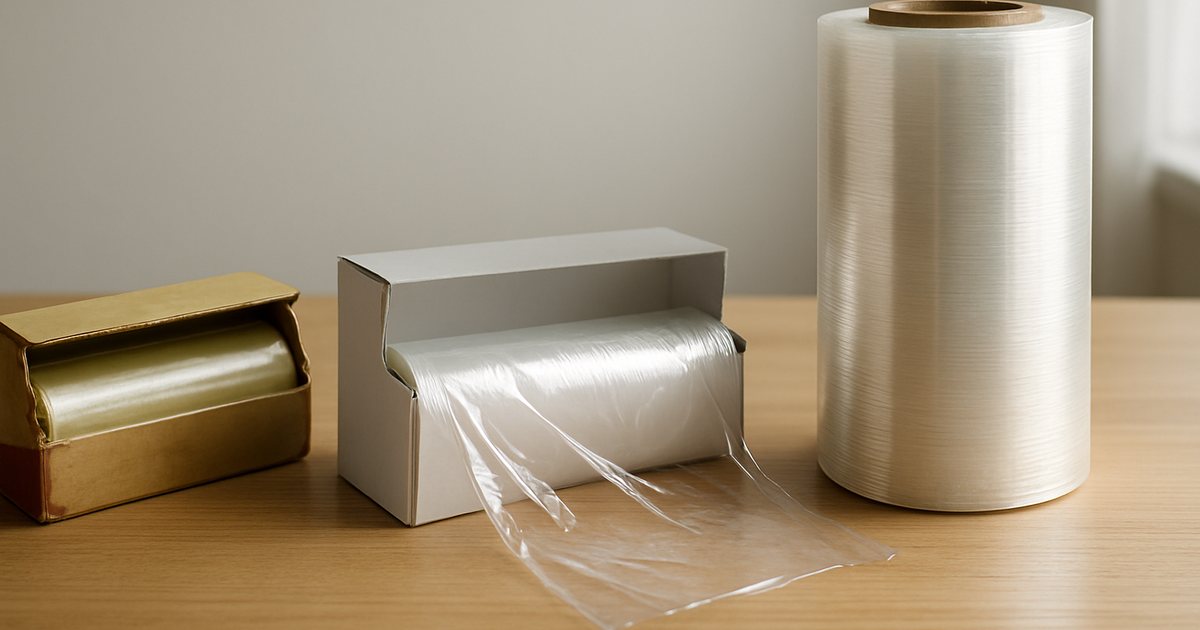
Quick answer: Cling film was not invented in one moment, and it was not invented in the UK. The material, polyvinylidene chloride (PVDC), was found by accident at Dow Chemical in Michigan in 1933. Dow trademarked it as Saran in 1940 and launched Saran Wrap as a household food wrap in 1949. Two other founding steps followed. Kureha launched Japan’s first household wrap, Krewrap, in 1960. Union Carbide launched polyethylene Glad Wrap in the US in 1963 and in Australia in 1966. In Britain, cling film became an everyday kitchen product during the 1960s and 1970s. The word “cling film” appears in dictionary records from the 1970s. By 1987 PVC cling film was used widely enough in UK shops that a plasticiser-migration finding became a national food-safety story.
We have manufactured PVC and PE cling film in Ningbo since 2004. Distributors ask us about this history more often than you’d expect, usually when they’re writing product copy and want the dates right. Most versions online get at least one date wrong. So here is the timeline with sources, and what each chapter means for the film you buy today.
Cling Film Timeline at a Glance
| Year | What happened | Material | Where |
|---|---|---|---|
| 1933 | Ralph Wiley finds a stubborn residue in lab glassware at Dow Chemical | PVDC | Midland, Michigan, USA |
| 1940 | Dow registers the “Saran” trademark | PVDC | USA |
| 1940s | PVDC film protects military equipment from salt and moisture in wartime shipping | PVDC | USA |
| 1947 | Dow staff Curly Irons and Russ Ludwig sell 12-inch × 25-foot rolls as “cling wrap” | PVDC | USA |
| 1949 | Dow launches Saran Wrap for household food wrapping | PVDC | USA |
| 1960 | Kureha launches Krewrap, Japan’s first household plastic wrap | PVDC | Japan |
| 1963 | Union Carbide launches Glad Wrap in the US | PE + tackifier | USA |
| 1966 | Glad Wrap launches in Australia, the first cling wrap sold there | PE | Australia |
| 1960s-70s | Cling film spreads through British kitchens and supermarket packing rooms | PVC and PE | UK |
| 1987 | UK findings on DEHA plasticiser migration from PVC film into cheese make headlines | Plasticised PVC | UK |
| 1990 | MAFF survey finds “old-style” high-migration PVC wrap no longer in use | PVC | UK |
| 1998 | S.C. Johnson acquires Saran Wrap from Dow | PVDC | USA |
| 2004 | US Saran Wrap reformulated from PVDC to polyethylene | PE | USA |
| 2011 | EU Regulation 10/2011 sets migration limits for plastic food-contact materials | All plastics | EU (retained in UK law after Brexit) |
| 2030 | New deadline for all English councils to collect plastic film from households (delayed from 2027) | Films incl. wrap | England |
The sections below go through each chapter. Pay attention to the material column. The film changed chemistry three times, and each change still shows up in today’s buying decisions.
1933-1949: A Lab Accident Becomes Saran Wrap
The story begins with a washing-up problem. In 1933, Dow Chemical lab worker Ralph Wiley was developing a dry-cleaning solvent (perchloroethylene). He found a residue in his beakers that wouldn’t scrub off. That residue was polyvinylidene chloride, or PVDC.
PVDC was waterproof, strong and very resistant to oxygen and moisture. Those properties still make it the benchmark barrier film today. Its early customers had nothing to do with food:
- Military protection. A division of General Motors asked for a flexible film to keep machine guns from corroding on their way overseas. PVDC became the standard wrap for anything that had to survive salt air.
- Boot insoles. In 1942, woven PVDC mesh was tested as a ventilating insole for jungle combat boots.
- Dow registered the Saran trademark in 1940 but didn’t sell it to consumers yet. Early PVDC was greenish and had an unpleasant smell. Wiley and his boss, John Reilly, had to fix both before it could go near food.
The step from military film to kitchen product came from inside Dow. In 1947, employees Carroll “Curly” Irons and Russ Ludwig bought spools of the film, cut it into 12-inch-wide, 25-foot rolls, and sold it as “cling wrap” on the side. Dow executive Charles Strosacker noticed. Dow bought their venture in 1948, and in 1949 launched Saran Wrap as a retail food wrap. Fridge ownership was growing fast in post-war American homes, and the product took off.
Why PVDC mattered: its oxygen permeability is about 0.6 cm³·µm/(m²·day·kPa) at 23°C and 95% relative humidity. That is far lower than polyethylene. No later cling film has matched it as a barrier. Our Saran Wrap guide covers the chemistry in more detail.
1960-1966: Three Countries, Three Chemistries
In the early 1960s, cling film split into the three families that still exist today.
Japan, 1960: PVDC for the home. Kureha launched Krewrap, the first household plastic wrap sold in Japan. Asahi Kasei, through a joint venture with Dow, brought Saran Wrap to Japanese consumers around the same time. Both Japanese brands have stayed with PVDC ever since. That is why Japanese households still use a higher-barrier, stickier wrap than most American households do.
Australia and the US, 1963-1966: polyethylene arrives. Union Carbide research chemist Douglas Lyons Ford developed a polyethylene film with a tackifier (“stickifier”) added. He worked at Union Carbide Australia’s Rhodes plant in Sydney. The film was made as a continuous tube by the blown-film method and then slit flat. Union Carbide launched it as Glad Wrap in the US in 1963, and Glad Wrap reached Australia in 1966. It was the first cling wrap on Australian shelves, which is why Australians still call any cling film “Glad Wrap”.
PVC: the professional’s film. Plasticised PVC was not a household-brand story. It grew out of the wider flexible-PVC industry. PVC can be made very soft and very clingy by adding plasticiser, and it recovers well after stretching. Those properties made it the standard for butcher trays, supermarket back rooms and catering kitchens, and it still is. Today a standard 300 mm × 1,500 m catering roll of 8-12 µm PVC cling film is a direct descendant of that period.
| Family | First household launch | Cling | Oxygen/moisture barrier | Relative cost | Where it dominates today |
|---|---|---|---|---|---|
| PVDC | 1949 (US), 1960 (Japan) | High | Best | Highest | Japanese households; specialty barrier packaging |
| Plasticised PVC | 1960s (professional use) | Highest | Medium | Low | Butchers, delis, catering, supermarket packing |
| Polyethylene (LDPE/LLDPE) | 1963 (US), 1966 (Australia) | Low to medium, needs tackifier | Lowest | Lowest | Retail household rolls in the US, UK and EU |
For a head-to-head comparison of the two families you can buy in bulk today, see PVC cling film vs PE cling wrap.
When Did Cling Film Arrive in the UK?
This is the question most UK searchers ask, and the honest answer has two parts.
First, nothing about cling film was invented in Britain. The PVDC chemistry is American, polyethylene cling wrap came out of Australia and the US, and Japan had household wrap by 1960. Several websites say plastic wrap was “appearing in households across the UK” by 1953. We could not find any source behind that date. It looks like the American “in homes since 1953” figure copied over to the UK.
Second, the evidence that does exist points to the 1960s and 1970s:
- The word itself. The Oxford English Dictionary’s evidence for the noun “cling film” begins in the 1970s. A product usually gets a settled everyday name only once people use it a lot. Before that, British shoppers bought branded products or simply said “plastic wrap”.
- The rise of the supermarket. British self-service supermarkets grew quickly through the 1960s. Pre-packed meat, cheese and produce on trays needed a clear, clingy overwrap, which was exactly the job PVC film was built for.
- The 1987 DEHA story. By the mid-1980s, PVC cling film was everywhere in British food retail. In 1987 UK findings showed the plasticiser DEHA migrating from PVC wrap into cheese and other fatty foods, and the story became national news. The London Food Commission campaigned on it between 1987 and 1990, and the Ministry of Agriculture, Fisheries and Food (MAFF) kept surveying plasticisers. A product has to be well established before its migration levels become a public-health issue.
So if you need one line for a product description: cling film was invented in the US (1933-1949) and became a standard British kitchen product in the 1960s and 1970s. For how the name differs by country, from “film transparente” to “Glad Wrap”, see our cling film names around the world guide.
Writing product copy or a private-label box? We supply PVC and PE cling film under your brand, with carton artwork, roll sizes and compliance paperwork done for your market. Tell us your market and roll size and we’ll send a spec sheet and FOB Ningbo quote within 24 hours.
1987-1990: The Plasticiser Scare That Changed PVC Film
This chapter matters most to anyone buying PVC cling film today, because it explains why a good PVC formulation looks different from a 1980s one.
Plasticised PVC food film is roughly a quarter to a third plasticiser by weight. The plasticiser makes it soft and clingy. The traditional choice was DEHA (di(2-ethylhexyl) adipate), and DEHA migrates into fatty foods.
- In the UK, the problem was first reported in 1987. The industry fixed it within a few years by replacing DEHA-only formulations with polymeric plasticisers, which migrate far less.
- A 1990 MAFF survey found the “old-style” PVC wrap was no longer in use in Britain.
- The US moved more slowly. In a 1998 letter to the FDA, Consumers Union reported finding 51-270 ppm DEHA (average 153 ppm) in cheese samples wrapped in PVC film at US supermarkets. That was eleven years after the UK had dealt with the issue.
Today the rules are explicit. EU Regulation 10/2011, which is still in force in the UK as retained law, sets a specific migration limit of 18 mg/kg for DEHA and an overall migration limit of 10 mg/dm². In the US, 21 CFR 178.3740 clears DEHA-plasticised film for fatty food only under refrigerated and frozen storage conditions. (Be careful here: many websites cite 21 CFR 177.1580 for PVC film, but that section covers polycarbonate resins.) Our DEHA vs ATBC plasticiser guide goes through the current limits in detail.
The manufacturer’s takeaway: “PVC cling film” is not one product. Two rolls that look identical can have completely different plasticiser systems. That is why we name the plasticiser on every spec sheet, and why you should ask for it by name.
1998-2004: Saran Goes Polyethylene
In 1998, S.C. Johnson bought Saran Wrap and Dow’s other consumer products. In 2004 it reformulated US Saran Wrap from PVDC to polyethylene, citing concerns about chlorinated materials. PE was also cheaper and easier to process.
The result is well known among cooks: the new Saran Wrap clung noticeably less. The brand lost share, and the name “Saran Wrap” no longer tells you what material is in the box. That is the source of much of today’s confusion between Saran Wrap, cling film and plastic wrap. Our cling wrap vs Saran Wrap vs plastic wrap explainer sorts out the names.
Japan did not follow. Asahi Kasei’s Saran Wrap and Kureha’s Krewrap are still PVDC, which is why a Japanese box and an American box with the same brand name behave so differently.
Regulation Timeline: How the Rules Caught Up
Cling film spread faster than the rules that govern it. Here is the regulatory history most relevant to anyone importing wrap today:
| Year | Rule | What it means for cling film |
|---|---|---|
| 1958 | US Food Additives Amendment | Food-contact substances, including plastics and plasticisers, need FDA clearance |
| 1987 | UK Materials and Articles in Contact with Food Regulations | UK framework for food-contact materials, adopted the same year as the DEHA findings |
| 2011 | EU Regulation 10/2011 (plastics) | Overall migration limit of 10 mg/dm²; SML for DEHA 18 mg/kg; standard food simulants and test conditions |
| 2021 | Brexit: 10/2011 retained in UK law | UK importers still need a 10/2011-style declaration of compliance |
| 2030 | England: plastic film collection from all households | Deadline moved from 31 March 2027 to 1 April 2030 (announced 16 July 2026) |
The last row is the newest chapter. England’s Simpler Recycling rules originally required every council to collect plastic film from homes by March 2027. In July 2026 the government pushed that deadline back to April 2030, after the industry raised concerns about end markets for recycled film. If you sell cling film in the UK, expect questions from retail buyers about recyclability and the resin identification on your packaging well before 2030.
Where Cling Film Is Made Today, and What the History Means for Your Order
The original brands were American, Japanese and Australian. Most bulk food-grade cling film is now extruded in Asia, and a large share of world PVC cling film comes from Chinese plants. Most of those plants cluster around Ningbo, Guangdong and Shandong. We have run PVC and PE lines in Ningbo since 2004. You can see how the film is actually made in our cling film manufacturing process guide.
Each chapter above left a lesson, and each lesson belongs as a line on your purchase order:
| History lesson | Year | What to write into your PO or spec sheet |
|---|---|---|
| Same brand, different resin | 2004 | Name the resin: PVC, PE (LDPE/LLDPE), or PVDC. Never just “plastic wrap” |
| Plasticisers migrate into fatty food | 1987 | Name the plasticiser system and ask for an EU 10/2011 or FDA migration test report on a fatty-food simulant |
| Reformulation cut cling | 2004 | State a cling or tack requirement and the surfaces the film must stick to (glass, PP tray, stainless steel) |
| Rules change after the product ships | 1958-2030 | Ask for a declaration of compliance for your destination market and confirm the resin code on the carton |
| Thin film tears in pro use | Ongoing | Specify gauge: 8-10 µm for household rolls, 10-12 µm for catering, 12-15 µm for meat and bone-in trays |
For reference, our current terms for food-grade PVC cling film are FOB Ningbo roughly $1,100-1,700 per tonne, depending on gauge, width and plasticiser system. MOQ is about 5 tonnes or one 20ft container of mixed sizes. Private label runs through our custom OEM cling film service. If your market is moving to PE for recyclability reasons, our PE cling film is made on the same site with the same paperwork.
The Short Version
- 1933: PVDC discovered by accident at Dow. 1949: Saran Wrap is the first household cling wrap.
- 1960: Japan gets Krewrap (PVDC). 1963/1966: Glad Wrap (polyethylene) launches in the US and then Australia.
- UK: not invented there. Cling film became a normal British product in the 1960s-70s, and by 1987 it was common enough for a plasticiser finding to make national news.
- 2004: US Saran Wrap switches to polyethylene. The brand name stops telling you the material.
- Today: buy by specification (resin, plasticiser, gauge, cling, compliance), not by brand or by the word “cling film”.
Need a spec sheet for PVC or PE cling film with the resin, plasticiser, gauge and migration data written out? Contact our export team with your target market and roll size, and we’ll reply with a quote and test reports.
Need a cling film quote while you're reading?
Our export team responds within 12 hours with FOB Ningbo pricing. No obligation.
Frequently Asked Questions
When was cling film invented?+
The material came first: Dow Chemical lab worker Ralph Wiley found polyvinylidene chloride (PVDC) in 1933, and Dow trademarked it as Saran in 1940. The kitchen product came later. Two Dow employees sold cut rolls as 'cling wrap' in 1947, and Dow launched Saran Wrap as a retail food wrap in 1949. That 1949 launch is the most defensible date for the invention of household cling film.
When was cling film invented in the UK?+
It wasn't invented in the UK. Every founding step happened elsewhere: PVDC film in the US (1933-1949), polyethylene cling wrap by Union Carbide in Australia and the US (early 1960s), and household PVDC wrap in Japan (1960). Cling film became an everyday British kitchen product during the 1960s and 1970s, and the Oxford English Dictionary's evidence for the noun 'cling film' begins in the 1970s. Claims that it was in British homes by 1953 cite no source.
Who invented plastic wrap?+
No single person did. Ralph Wiley discovered the PVDC residue at Dow in 1933. Dow staff, including Wiley's boss John Reilly, made it usable. Carroll 'Curly' Irons and Russ Ludwig turned it into a rolled kitchen product in 1947. Chemist Douglas Lyons Ford developed the polyethylene cling wrap that became Glad Wrap at Union Carbide's Rhodes plant in Sydney in the early 1960s. PVC cling film, which dominates professional food wrapping today, grew out of the wider flexible-PVC industry and has no single named inventor.
Is cling film the same material it was in the 1950s?+
Usually not. The original Saran Wrap was PVDC. Most cling film sold today is either plasticised PVC, which dominates butcher, deli and catering use, or polyethylene, which dominates retail household rolls. US Saran Wrap itself switched from PVDC to polyethylene in 2004. PVC film also changed on the inside: after UK surveys in 1987 found the plasticiser DEHA migrating into cheese, manufacturers moved to polymeric and lower-migration plasticiser systems.
Why is it called cling film in the UK but plastic wrap or Saran Wrap in the US?+
In the US, Saran Wrap was the first big retail brand (1949), so its name became generic, the same way people say Kleenex. The UK never had one dominant brand name that took over, so the descriptive term 'cling film' won. Australia says 'Glad Wrap' for the same reason, because Glad was the first cling wrap on Australian shelves in 1966. Our terminology guide maps the name used in more than a dozen countries.
What does cling film history mean for someone buying it wholesale today?+
Each turning point in the history left a spec line you should put on a purchase order. The PVDC-to-PE switch means you should name the resin. The 1987 DEHA findings mean you should name the plasticiser and ask for a migration test on fatty food. The 2004 reformulation, which cut cling, means you should state a cling or tack requirement. The recycling debate means you should confirm what your market's packaging rules require. A factory that can't answer these four is not a manufacturer.
Sourcing cling film and have questions this article didn't answer?
Related articles
How Cling Film Is Made: PVC & PE Manufacturing Process Explained
How is cling film made? Complete guide to the cling film manufacturing process — from PVC resin compounding and calendering to PE blown film extrusion, slitting, quality control and packaging. Includes factory floor insights from a 20-year manufacturer.
Another Name for Cling Wrap? Every Regional Term for Food Film Explained
What is another name for cling wrap, cling film, Saran Wrap, or plastic wrap? This guide covers every regional term, brand name, and trade synonym used worldwide — from North America to Europe, Australia, and Asia — so buyers and suppliers always speak the same language.
Cling Film Plasticizers: DEHA vs ATBC Limits 2026
DEHA's EU limit is 18 mg/kg, but the 60 mg/kg total-plasticizer cap is what fails films. Factory guide to DEHA vs ATBC, EU 10/2011 and FDA rules. Get a quote →