
Technical Guides
Industrial Cling Film Wrap: Specs & Supplier Guide
Industrial Cling Film Wrap: The Complete Specification & Sourcing Guide
Industrial cling film wrap is the heavy-duty, large-format version of the household plastic wrap most people know as saran wrap or cling film. Where household cling wrap comes in small rolls (30-100 meters) designed for covering a bowl of leftovers, industrial cling film comes in professional-grade rolls (500-5,000 meters), at thicker gauges (12-30 microns), in wider widths (380-600mm), and with performance specifications tuned for high-speed machine wrapping, commercial kitchen use, and food-processing operations.
If you are sourcing industrial cling film for a supermarket chain, restaurant group, food processor, meat-packing facility, or distribution business, this guide covers everything you need to specify: thickness selection, material comparison (PVC vs PE), machine compatibility, food-safety compliance, and how to evaluate a cling film supplier who can deliver consistent quality at scale.
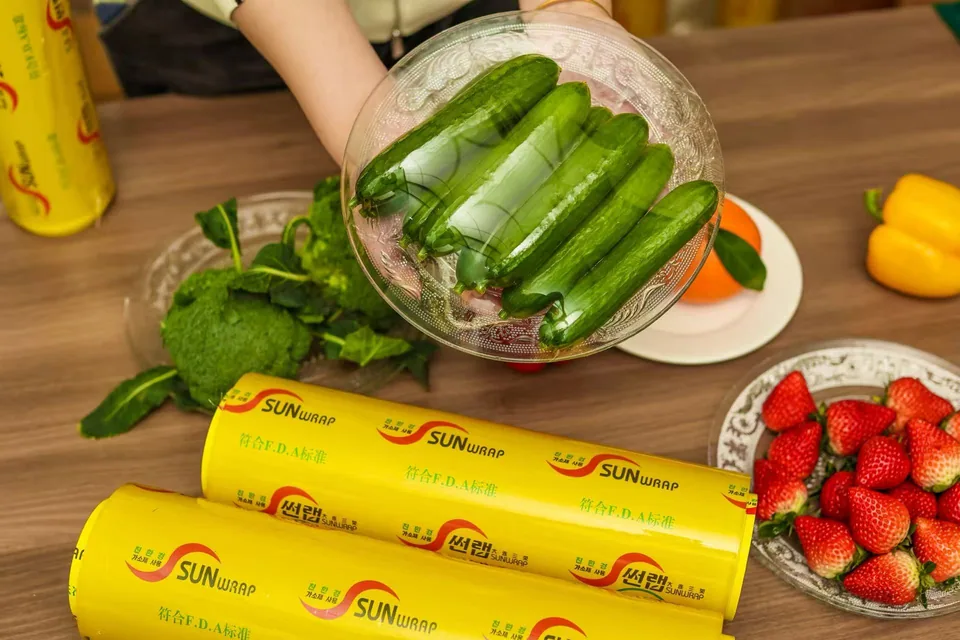
What Makes Cling Film “Industrial”?
The distinction between household and industrial cling film is not just about roll size — it is about performance requirements:
| Feature | Household Cling Film | Industrial Cling Film |
|---|---|---|
| Thickness | 8-10 microns | 12-30 microns |
| Width | 250-300 mm | 380-600 mm |
| Roll length | 30-100 meters | 500-5,000 meters |
| Core diameter | 1 inch | 1.5 or 3 inch |
| Cling requirement | Moderate (hand use) | High (machine tension) |
| Thickness tolerance | +/-1.0 microns | +/-0.5 microns |
| Anti-fog treatment | Optional | Standard (for chilled display) |
| Packaging | Color retail box | Shrink-wrapped or plain box |
| Typical buyer | Consumer / grocery store | Supermarket chain, food processor, distributor |
Why the tighter specifications matter: An automatic tray-wrapping machine cycles 15-25 trays per minute. If the film thickness varies by more than 0.5 microns across the roll width, the machine produces uneven seals — some trays too tight (product compression), others too loose (film lifts during display). One bad jumbo roll can cause 2-4 hours of machine downtime for adjustment. At a supermarket fresh counter wrapping 2,000+ trays per day, that downtime translates directly to labor cost and lost sales.
This is why industrial buyers cannot simply buy the cheapest cling film available — they need a cling film supplier who delivers consistent specifications batch after batch.
Industrial Cling Film Thickness Guide
Choosing the right thickness is the single most important specification decision for industrial cling film. Too thin and the film tears during wrapping. Too thick and you waste material and increase cost per unit wrapped.
Thickness by application
| Application | Recommended Thickness | Material | Why This Gauge |
|---|---|---|---|
| Automatic tray wrappers (supermarket) | 10-12 microns | PVC | Optimal stretch/cling ratio for machine speed |
| Semi-automatic wrappers | 12-14 microns | PVC | Extra thickness compensates for less precise tension control |
| Manual food-service wrapping (restaurant, hotel, catering) | 12-15 microns | PVC or PE | Tear resistance for hand use, covers irregular shapes |
| Meat wrapping (bone-in cuts, poultry) | 15-17 microns | PVC | Puncture resistance against sharp bone edges |
| Cheese wrapping | 12-14 microns | PVC | Balance of oxygen barrier and cling for irregular shapes |
| Cold storage / freezer | 18-22 microns | PE | Maintains flexibility at -20 to -40 C |
| Pallet overwrap (food-safe) | 22-30 microns | PVC or PE | Load stabilization plus food-contact compliance |
| Machine rewinding (jumbo to retail) | 8-10 microns | PVC | Thin gauge for consumer roll conversion |
Thickness and cost trade-off
The relationship between thickness and cost is linear for the same material:
| Thickness | Approximate Weight per Roll (45cm x 1,500m) | Cost Multiplier |
|---|---|---|
| 10 microns | 8.5 kg | 1.0x (baseline) |
| 12 microns | 10.2 kg | 1.20x |
| 14 microns | 11.9 kg | 1.40x |
| 17 microns | 14.5 kg | 1.70x |
| 20 microns | 17.0 kg | 2.00x |
Practical guidance: For most food-service applications, 12 microns is the sweet spot — thick enough to handle without tearing, thin enough to be economical at high volumes. Only upgrade to 15-17 microns if you are wrapping bone-in meat or heavy items that would puncture thinner film.
For the full thickness chart with performance data at every gauge, see our PVC Cling Film Thickness Chart Guide.
PVC vs PE for Industrial Cling Film: Which to Choose
The material decision for industrial cling film depends on your specific application:
PVC industrial cling film
Best for: Supermarket fresh-food display, deli counters, meat wrapping, automatic tray wrappers, any application where visual clarity and self-cling are critical.
Properties:
- Crystal clear transparency (92-95% light transmission)
- Strong self-cling to glass, ceramic, metal, and the film itself
- Anti-fog treatment prevents condensation droplets on chilled displays
- Thinner gauges possible (10-12 microns work well because PVC has inherent strength)
- Temperature range: -20 C to +60 C
- NOT microwave safe (plasticizer migration at high temperatures)
- Meets FDA 21 CFR 177.1580 for food contact at room temperature and below
Cost: $3.50-4.50 per jumbo roll (45cm x 1,500m, 10 microns, FOB Ningbo)
PE industrial cling film
Best for: Microwave-safe food service (hot-holding, reheating), freezer storage, markets with PVC restrictions, buyers with “PVC-free” procurement policies.
Properties:
- Good clarity but slight milky haze compared to PVC
- Moderate cling (relies on static charge, not plasticizers)
- Microwave safe up to 110 C / 230 F
- BPA-free, no plasticizers
- Recyclable (LDPE, plastic code #4)
- Thicker gauges needed (12-15 microns minimum) because PE has lower tensile strength than PVC
- Temperature range: -40 C to +110 C
Cost: $4.50-6.00 per jumbo roll (45cm x 1,500m, 12 microns, FOB Ningbo)
Decision matrix
| Requirement | Choose PVC | Choose PE |
|---|---|---|
| Supermarket fresh display | Yes | — |
| Meat department wrapping | Yes | — |
| Restaurant cold prep | Yes | — |
| Microwave reheating | — | Yes |
| Freezer storage below -20 C | — | Yes |
| ”PVC-free” procurement policy | — | Yes |
| Lowest cost per meter | Yes | — |
| Best optical clarity | Yes | — |
| Strongest self-cling | Yes | — |
Most large food-service distributors carry both PVC and PE industrial cling film to serve the full range of customer requirements.
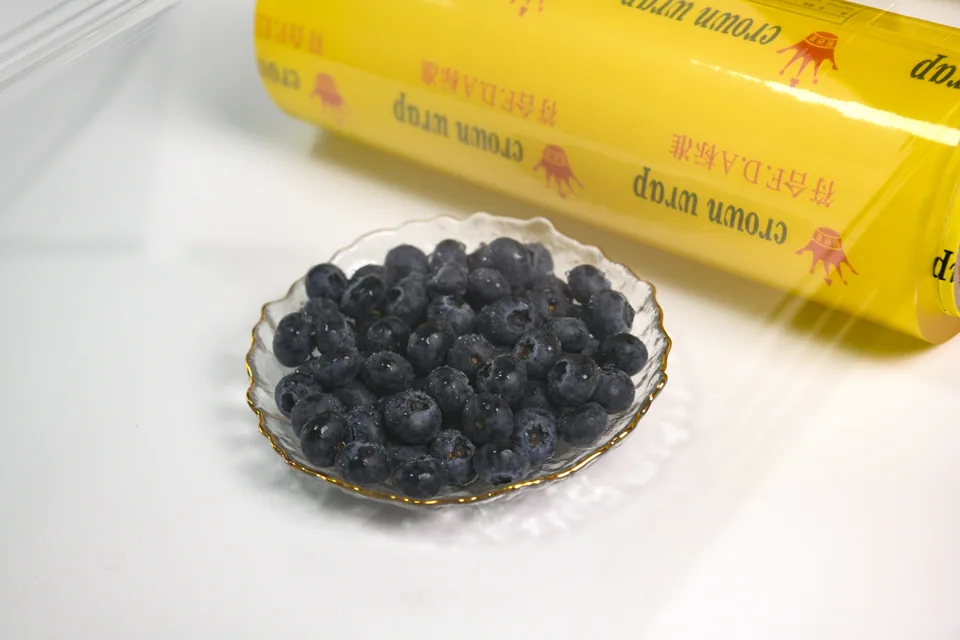
Industrial Cling Film vs Stretch Film: Know the Difference
A common sourcing mistake — especially among buyers new to the food-packaging category — is confusing industrial cling film with stretch film. They are different products designed for completely different applications:
| Property | Industrial Cling Film | Stretch Film (Pallet Wrap) |
|---|---|---|
| Primary purpose | Food wrapping | Load stabilization |
| Food safe? | Yes (FDA compliant) | No — not for food contact |
| Material | PVC or PE | LLDPE (linear low-density polyethylene) |
| Thickness | 10-30 microns | 17-35 microns |
| Stretch capability | 150-250% | 200-300% |
| Cling | Self-cling (both sides) | Tacky on one side only |
| Transparency | Crystal clear | Translucent (tinted options common) |
| Roll width | 250-600 mm | 450-500 mm (standard) |
| Core | 1”-3” | 3” (machine) or handheld |
Critical safety point: Stretch film is NOT food-safe. It is not manufactured with food-grade plasticizers, it is not FDA-compliant for food contact, and it should never be used to wrap food — even indirectly. If a restaurant or food processor is using stretch film to wrap food trays, they are creating a food-safety compliance risk.
If you need food-safe pallet overwrap (for example, wrapping entire pallets of food products in a cold storage facility), specify food-grade PVC or PE cling film in 22-30 micron thickness — not industrial stretch film.
For a detailed comparison of all film types, see our Stretch Film vs Cling Film Guide.
Machine Compatibility: Getting Industrial Cling Film to Run on Your Equipment
For buyers using automatic or semi-automatic wrapping machines, film-machine compatibility is not optional — it is the most important factor after food-safety compliance.
Key compatibility factors
1. Thickness uniformity
The film must maintain consistent thickness across its full width (edge-to-edge variation within +/-0.5 microns). Uneven thickness causes:
- Machine jams at thin spots
- Uneven tension (one side pulls more than the other)
- Inconsistent seal quality
- Premature tearing at weak points
How to test: Request a sample roll from your prospective cling film supplier and measure thickness at 5 points across the width using a digital micrometer (0.001mm resolution). Measure at 3 locations along the roll (start, middle, end). Acceptable variation is +/-0.5 microns from the stated thickness.
2. Core dimensions
Industrial wrapping machines require specific core inner diameters:
- 3-inch core — Standard for most automatic tray-wrappers (Mettler Toledo, Ishida, Digi, ULMA)
- 1.5-inch core — Some semi-automatic machines and wall-mounted dispensers
- 1-inch core — Compact dispensers, manual use
A roll with the wrong core diameter will not fit the machine spindle. Always specify core size when ordering.
3. Cling level calibration
Too much cling causes the film to stick to machine guides and rollers, creating jams. Too little cling produces wraps that lift off the tray during display. The ideal cling force for machine wrapping is:
- Automatic tray wrappers: 20-30 N/m
- Semi-automatic / hand-stretch: 25-35 N/m
- Manual (no machine): 30-40 N/m
Experienced manufacturers like SUNWRAP calibrate cling force based on the buyer’s specific machine type and wrapping speed.
4. Anti-static treatment
In high-speed wrapping operations (15+ trays per minute), static charge buildup can cause the film to cling to metal guides and sensors, triggering machine stops. Anti-static treatment reduces these incidents. This is a standard feature on SUNWRAP’s machine-grade PVC cling film but may not be standard from all suppliers — always ask.
How to Evaluate an Industrial Cling Film Supplier
Finding a reliable cling film supplier is critical for any industrial application. Here are the five evaluation criteria that matter most:
1. Production capacity and consistency
Ask for:
- Monthly output in tonnes — A credible industrial supplier produces 300+ tonnes/month
- Number of extrusion lines — Multiple lines mean they can schedule your orders without blocking other customers
- Current capacity utilization — A factory at 95% capacity cannot handle your urgent reorders
2. Food-safety documentation
Non-negotiable documents for any industrial food-contact cling film:
| Document | What It Proves | Validity |
|---|---|---|
| FDA 21 CFR 177.1580 | US food-contact compliance | Ongoing (formulation-based) |
| SGS migration test report | No harmful chemical migration | 12 months from issue date |
| EU Regulation 10/2011 DoC | European food-contact compliance | Ongoing (formulation-based) |
| ISO 9001 | Quality management system | 3 years (annual audits) |
| COA (per lot) | Specific batch test results | Per production lot |
Red flag: If a supplier cannot produce an SGS or equivalent third-party test report within 24 hours of your request, they either do not have one or are hiding a non-compliant result. Walk away.
3. Thickness control and QC process
Request:
- Sample rolls for independent thickness measurement
- Description of their QC process (when, how, and how often they measure)
- Retained-sample policy (do they keep samples from every production lot?)
- Reject rate data (what percentage of production fails their internal QC?)
4. Machine compatibility testing
A good industrial cling film supplier will:
- Ask what wrapping machines you use (brand, model, speed)
- Provide samples specifically optimized for your machine type
- Send a technical data sheet with cling force, tensile strength, and elongation data
- Accept responsibility (replacement or credit) if their film causes machine issues that are attributable to film quality
5. Export track record
Ask:
- How many containers per month do they export? (Good: 50+. Acceptable: 20+. Risky: <10)
- Which countries do they ship to? (A supplier experienced in your destination’s import requirements will handle documentation correctly)
- Can they provide references from existing customers in your market?
For the complete supplier evaluation framework, see our Cling Film Supplier Sourcing Guide.
Industrial Cling Film Pricing (2026)
Current pricing for industrial cling film from Chinese manufacturers, FOB Ningbo:
| Product | Specification | Price Range |
|---|---|---|
| PVC, machine grade | 45cm x 1,500m, 10μm, 3” core | $3.50-4.50/roll |
| PVC, food-service | 45cm x 500m, 12μm, 1.5” core | $1.80-2.30/roll |
| PVC, meat wrapping | 45cm x 1,500m, 15μm, 3” core | $5.00-6.50/roll |
| PVC, cold storage | 50cm x 1,000m, 20μm, 3” core | $5.50-7.00/roll |
| PE, microwave-safe | 45cm x 500m, 12μm, 1.5” core | $2.20-2.80/roll |
| PE, freezer grade | 45cm x 1,000m, 15μm, 3” core | $4.00-5.00/roll |
Minimum order: One 20-foot container (~2,500 jumbo rolls or ~8,000 food-service rolls). Trial orders of 500-1,000 rolls negotiable for first-time buyers.
Custom pricing factors that increase cost:
- Custom-printed dispenser boxes: +$0.10-0.20 per roll (plus $200-500 plate charge for first order)
- Non-standard widths or lengths: +5-10%
- Anti-fog premium treatment: +3-5%
- Rush production (less than 15 days): +10-15%
For a line-by-line cost breakdown, see our Cling Film Price Guide 2026.
Common Mistakes When Sourcing Industrial Cling Film
After 20 years of exporting industrial cling film, we see the same sourcing mistakes repeatedly:
Mistake 1: Choosing by price alone
The cheapest cling film from China often has poor thickness consistency — it will jam your machines, tear during wrapping, and generate customer complaints. The cost of machine downtime, waste, and lost customers far exceeds the $0.10-0.20 per roll you save.
Mistake 2: Not specifying thickness precisely enough
“12 micron” means different things at different factories if they do not control to the same tolerance. Always specify the tolerance (e.g., “12 microns +/-0.5”) and test incoming shipments with a micrometer.
Mistake 3: Using household cling film for commercial applications
Household-grade 8-10 micron film in 30m rolls is not designed for commercial wrapping operations. It tears too easily, the rolls are too small (constant roll changes), and the per-meter cost is actually higher than buying proper industrial rolls.
Mistake 4: Confusing stretch film with cling film
As explained above, stretch film is not food-safe. We have seen cases where buyers ordered “industrial plastic wrap” and received pallet stretch film instead — unusable for food applications and a potential regulatory violation.
Mistake 5: Not testing machine compatibility before committing to a container
Always order sample rolls and test them on your actual wrapping machines before placing a container order. What runs perfectly on one machine brand may jam on another due to differences in tension, guide geometry, and heat-seal temperature.
Industrial Cling Film Applications by Industry
Supermarket fresh-food departments
The single largest consumer of industrial cling film worldwide. A typical supermarket with a fresh-food counter uses 50-100 rolls per month. Requirements: 10-12 micron PVC, anti-fog treatment, machine-grade thickness consistency, clear retail-quality appearance.
Meat processing and packaging
Meat packers require thick (15-17 micron) PVC cling film with high puncture resistance for bone-in cuts, strong seal integrity to prevent drip leakage, and consistent performance on high-speed tray wrappers processing 2,000+ trays per shift. See our Meat Wrapping Guide for detailed specifications.
Restaurant, hotel, and catering (HORECA)
Kitchens use 12-15 micron cling film for prep-station food coverage, ingredient storage, and plating protection. The key requirement is cling strength on irregular surfaces (bowls, pans, plates of different sizes). See our HORECA Cling Film Guide.
Food processing and central kitchens
Food processors wrapping ready meals, pre-cut vegetables, or bakery products need consistent machine-grade film in long-format rolls (1,500-5,000m) to minimize roll changes on production lines.
Cold storage and distribution
Warehouses storing palletized food products at -20 C or below need thick (20-30 micron) cling film that maintains flexibility and cling at low temperatures. PE is preferred for sub-zero applications because PVC becomes brittle below -20 C.
The Bottom Line
Industrial cling film wrap is a performance-critical consumable for any commercial food operation. The right specification — correct thickness, correct material, correct machine compatibility — makes the difference between smooth operations and constant machine jams, product waste, and customer complaints.
The key decisions are:
- Thickness — Match to your application using the guide above
- Material — PVC for cold display and wrapping; PE for microwave and freezer
- Supplier — Evaluate on consistency, documentation, and export experience, not just price
Contact SUNWRAP for industrial cling film samples and FOB Ningbo pricing. Specify your wrapping machine brand/model, target thickness, and monthly volume — we will provide a quotation and production timeline within one working day.
SUNWRAP is a Korean-invested PVC cling film manufacturer in Ningbo, China — producing machine-grade, food-service, and heavy-duty industrial cling film for export to 50+ countries since 2004. FDA-compliant, SGS-tested, with dedicated extrusion lines for industrial-specification production. Request a quote →
Need a cling film quote while you're reading?
Our export team responds within 12 hours with FOB Ningbo pricing. No obligation.
Frequently Asked Questions
What is industrial cling film wrap?+
Industrial cling film wrap refers to heavy-duty, large-format cling film designed for commercial and industrial food applications — not household use. It is typically thicker (12-30 microns vs 8-10 for household), wider (380-600mm vs 250-300mm for household), and comes in longer rolls (500-5,000 meters vs 30-100 meters for household). Industrial cling film is used in supermarket tray-wrapping machines, meat-processing lines, commercial kitchens, food-processing plants, and cold-storage facilities.
What thickness should industrial cling film be?+
It depends on the application. For supermarket automatic tray-wrapping machines: 10-12 microns. For manual food-service wrapping (restaurants, catering): 12-14 microns. For meat wrapping with bone-in cuts: 15-17 microns. For cold storage and pallet overwrap: 20-30 microns. Thicker film costs more per meter but reduces tearing, punctures, and machine jams — so the right thickness for your application is the one that minimizes total cost including waste and downtime.
What is the difference between cling film and stretch film?+
Cling film (also called cling wrap or saran wrap) is designed for food contact — it clings to itself and smooth surfaces, is transparent, and is food-safe. Stretch film (also called stretch wrap or pallet wrap) is designed for load stabilization — it stretches 200-300% to tightly bind items on pallets. Stretch film is thicker (17-35 microns), has a tacky side and a smooth side, and is NOT food-safe. Never use stretch film for food wrapping, and cling film is not strong enough for pallet wrapping.
How do I choose an industrial cling film supplier?+
Evaluate on five criteria: 1) Production capacity — can they fulfill your monthly volume without delays? 2) Thickness consistency — request a sample and measure with a micrometer, tolerance should be +/-0.5 microns. 3) Food-safety certifications — FDA 21 CFR 177.1580, SGS migration test report dated within 12 months. 4) Machine compatibility — their film must run cleanly on your specific wrapping machines. 5) Export experience — how many containers per month do they ship, and to which countries? A factory doing 50+ containers per month to your region is a safer bet than one doing 5.
Can industrial cling film be used on automatic wrapping machines?+
Yes — in fact, machine wrapping is one of the primary applications for industrial cling film. The film must be manufactured to tight thickness tolerances (10-12 microns, +/-0.5) to prevent jams and tears on automatic tray-wrappers. Key properties for machine use: consistent thickness, uniform cling across the roll width, no static buildup that causes film sticking to guides, and proper core diameter (typically 3-inch for industrial machines). SUNWRAP produces machine-grade PVC cling film specifically optimized for automatic wrappers.
Sourcing cling film and have questions this article didn't answer?
Related articles
PVC Cling Film Supplier: Wholesale Sourcing Guide — Factory vs Trader (2026)
Find a real PVC cling film supplier, not a trader. 8 factory evaluation criteria, China vs India vs Malaysia pricing ($1,100–$1,600/tonne), MOQ 3 tonnes. Red flags that cost importers $15K/container →
Cling Wrap vs Cling Film vs Stretch Film
Cling wrap = cling film (same product, different names). Stretch film = pallet wrap (NOT food-safe). Ordering the wrong one costs $8,000+ per container. Quick comparison with specs from a manufacturer.
HoReCa Cling Film: Restaurant & Catering
Complete guide for HORECA buyers sourcing cling film: 300m catering rolls, food service wrap specifications, dispenser compatibility, bulk pricing for restaurants/hotels/catering, and industrial-grade cling for commercial kitchens.